Saturday, September 8, 2018

Day 783 to 793 of the Third Voyage: In which we decide to try the “other cruising” and let someone else do the driving for a change.


Prior to becoming cruisers (as in people who live on boats with dreams of seeing the world, but instead spend most of their time fixing things so they can make it another twenty miles before breaking down again), we were cruisers (as in people who vacation on cruise ships where the likelihood of breaking down is infinitely smaller but if you do, it’s someone else’s problem.)

The first cruise the Deck Boss and I went on was back in 1977—the same year that the Love Boat debuted. Back then, the ships were much smaller—maybe 450-500 passengers—and they still looked “shiply” as opposed to today’s megamonsters that resemble skyscrapers that were tipped over on their side and barged out to sea. Today’s ships carry so many passengers, that you rarely see the same person twice (unless he struts around with his own theme music, in which case you see him every day.) But back in the early days, it was more of an intimate experience where you got to know people and it was not uncommon to hobnob with officers of the ship up to and including the captain, although he tended to be more grizzled Norwegian mariner and less Murray from the Mary Tyler Moore Show.  The cabins were tiny—smaller than our aft cabin on Raven—and there were no balconies, settees, and minifridges. There was one main dining room, a couple of bars, a big lounge, and a shop that sold toiletries and souvenirs sporting the ship’s logo. In lieu of the Broadway-caliber shows they have now, entertainment consisted of lounge singers, second-string comedians, and whatever talent the crew possessed. On the final day at sea, passengers were given access to artsy/craftsy items and invited to participate in a costume contest for the amusement of everyone else. And when my dad rolled up his pant legs, donned a construction paper tutu and wings, walked out on stage as a bargain-basement tooth fairy, and proclaimed in his best Groucho Marx voice, “For these rates, you were expecting George Burns?”, he instantly became my hero for life. (He won the contest, in case you were wondering.)

Nowadays, it’s all about volume. How many people/restaurants/bars/shops/activities you can fit on one ship. And if you need more of those things to one-up your competitors, just build a bigger ship. If your competitor’s ship carries 3600 passengers, you’d better up the ante by at least 10% (20% if you’re a real player.) If they put in a water park, build a bigger one and add a ropes course. They’ll then see your water park and ropes course and raise you a boardwalk, shark tank, and roller coaster.  Editor’s Note: One ship currently plying the seas has a skating rink, so you just know there’s a ship designer somewhere trying to figure out where to incorporate a small ski hill and a Yeti encounter. But that’s not to say the new cruise ships don’t have their place in the world. Sure, they may be huge and loud and full of humanity, but you still get to sample exotic ports of call, eat yourself silly, and (hopefully) relax. Because no matter how big a ship is, it’s still possible to find your own quiet corner of a bar to read, play cards, or just stare out at the endless expanse of sea (mainly because the other 3,960 passengers are jockeying for a spot by the pool.) By consensus, we all still prefer the smaller ships, but as far as vacations go, it’s still a great way to travel. And since it was a cruise ship that got us into our current situation (reference the blog entry titled, “The Eve of the 2nd Voyage”), we thought it might be fun to see what kind of mischief a second one would lead to.

Of course, one can handle only so much mischief at a time.


But, as someone once said, “The journey of a thousand miles begins with a single step.” So, at this point, I’d like to send a shout out to our new least favorite airline, American, for making sure that first step started out on the wrong foot. So, here’s the scenario…I booked our tickets a good month in advance. They knew we were coming. They knew we were travelling together. So why do we get on board and find a woman with a small child sitting in the Captain’s aisle seat? Because American booked a family of six—a mother, a grandmother, two school-age kids, one baby and one toddler—into four seats and then insisted that the family “must stay together” and that the Captain would have to move so that the grandmother/toddler could sit across from the others. Like they couldn’t figure this out during the reservation/seat assignment stage? What about our family? Do we not rate? Now maybe this seems petty to you, but here’s the kicker…the Captain received free drinks during the flight for the “inconvenience” of having to move. Excuse me? Who was inconvenienced? The Deck Boss and I were the ones that had to sit next to a screaming, squirming toddler for three hours. Where was our free booze? They didn’t even offer a replacement when the wine we paid for was kicked off the tray table by the kid after she had a meltdown when her video stalled. At the very least, where were our complimentary headphones to muffle out the soul-sickening sounds of Elmo en Espanol? Petty? Maybe. But given the cost of a ticket and the expectation of a journey that doesn’t look, sound, and smell like Romper Room on a hot afternoon, I think we’re entitled to be a bit perturbed.

Of course, we were a little agitated even before we set foot on the plane having spent an hour going through the various stages of security in the San Salvador airport aka the “just doing my job-athon”.  Now I get why security is tight and I understand why they must take precautions, so when the security officer asked where my “encendedor” was, I shouldn’t have been surprised except for the fact that I don’t own a lighter. But he had seen it on the scanner, so it must be there. He then proceeded to rummage through my tray, inspect all the contents of my purse and “liquids baggy”, open a bottle of contact lens solution (?), and turn my iPad over and over looking for the offending lighter. He finally gave up, grabbed the Deck Boss’ carry on (?) and herded us over to the inspection table. Everything came out. No lighter. But what’s this? Cuticle nippers? No es permiso. And this? A nail file? No es permiso. And into the trash they went. We repacked and headed for the gate where we got to go through the second security checkpoint. Here, they searched my purse again, pulled out my boat key and we played 21 questions: “What is this? What does it open? What else does it open? Are you sure this is a key? What did you say it opened? Where is the thing that this opens?” And on and on. Finally satisfied with my answers, they turned to the Deck Boss’ purse, pulled out her boat key (identical to mine), asked the same questions, hemmed and hawed, and then sent us on our way. The Captain, meanwhile, had his lighter confiscated. So, to recap…back at the main circus tent, they tossed the Deck Boss’ bag searching for an item they think they saw in my tray for something that went through in the Captain’s backpack. That’s efficiency Salvadoran style! But, in their defense, they did get the job done which is more than TSA can say. Editor’s Note: In case you were wondering, yes…disposable lighters are allowed on airplanes now, although we have found that they still get confiscated about 25% of the time. In other words, we’re pretty sure security approval is revoked when it’s time to go on a smoke break. But whatever. It’s the modern age of security where every old lady with a manicure kit is really a terrorist and Linda the “air hostess” is really Tom Cruise in a latex mask. He’s been instructed to “stop this plane at any cost” up to and including a hard landing on the Vegas Strip because simply snatching an octogenarian off the street would attract too much attention.
Your cuticles or your life!


Pictured:  Boat Key. To be fair…as far as keys go, it is pretty impressive. Besides Raven, it will also unlock the door to any airplane cockpit, the White House, Ft Knox, and Tom Cruise’s summer home. The floatie-fob converts into a mini-sub. 

But I digress….Having finally arrived in Miami, we then had to endure almost two hours at immigration and customs and another 45 minutes huffing car fumes waiting for the shuttle before finally arriving at the hotel… thoroughly irritated, light-headed, and snapping at each other. You know, exactly how you want to start a vacation. Luckily, we had set aside all of Saturday to hang with some good friends and see some sights, so we were in a much better frame of mind come cruise time.
On Sunday, we went to meet our ship, NCL’s Getaway. I’d show you a picture, but I neglected to take one. Mainly because it’s fugly. Seriously. If you don’t feel like Googling it, just picture a low-slung, neo-modern apartment block, stick a stubby bow on it, and slap some “art” on the side and you’ve pretty much got it. But since you don’t have to look at it when you’re on it, it doesn’t really matter what it looks like. The inside décor was quite nice and with 21 restaurants, a dozen bars, swimming pools, ropes course, lounges, theaters, arcades, casino, etc. etc. there was plenty to do and see. Passenger count: 3,963 not including crew. 
At this point, I won’t bore you with our day-to-day activities, especially since most of the time was spent decompressing in the various watering holes and stuffing our faces, so please enjoy these craptacular camera-phone photos…

We had been on board all of ten minutes, but as our cabins weren’t ready, the Mixx Bar one floor up seemed the logical place to wait it out. Over the course of the trip, this became our go-to bar in the evenings and we got to be chummy with the bartenders, which was fortuitous when, after a spectacular night of drinking, they had to help me get the Captain upright after he did a Dick Van Dyke and tripped over the furniture slamming into a glass-topped table. He was too far gone to pull off the customary, “Who put that there?” look, but as it was the last night of the cruise, he had nothing to live down. 
Editor’s Note: Since we’ve been on the NCL cruise line numerous times before, we were eligible for certain perks, one of which was an unlimited drinks package which, had they taken a minute to check the bar tabs on our previous cruises, they would have realized was a colossal mistake on their part. They might have broken even on me and the Deck Boss. But with the Captain, they definitely lost money. In fact, I’m pretty sure they had to run into Cozumel and get more rum.
Lifeboat drills:  On smaller ships, your muster station is on deck next to your appointed lifeboat. With 3,963 passengers on board, mustering stations are throughout the public rooms of the ship with the understanding that crew members will lead you to where you need to go in the event of a disaster. Our mustering station was at the Atrium Bar. Because if you’re going to go down, you may as well go down with a nice buzz...
In case of emergency, bring glass.


Meanwhile, back at the cabin…
A staple of all cruise lines, the room stewards like to place a towel animal on your bed in the evenings. Our guy was an awesome dude, but a novice in the art of the towel animal. Either that or he was working on the next generation of Rorschach test. 

This is either an elephant with its head on backwards or the back end of a cat.


And this is either a bunny with mumps, two people discussing geothermal politics, or the back end of a cat.

First port of call…Roatan, Honduras.  When you don’t book a tour and opt to take your chances at a kiosk on the dock, you get this guy…Shelford Dilbert. Don’t let the spit-shine on the twenty-year-old minivan fool you, it was a total POS. The undercarriage was rusted, the upholstery had holes, and when the Captain slid the door closed, half the insulation fell out. But the A/C worked, and Shelford was an excellent guide. We had a blast! He drove us all over the southern half of the island, showed us places only the locals went, took us to an animal sanctuary, bought us local beer, drove us up to the best viewpoint on the island (which happened to be at the rum distillery), and hooked the Deck Boss up with some local noni juice which is supposed to be good for the joints and may just put a little giddy-up in her go. 
At the animal sanctuary. A touching moment between two of the slowest beings on earth.
If you’re going to pull off a monkey suit, do it with confidence.


Sue’s Noni Juice: the cure for whichever of the “300 diseases of the body” ails you.


Second port of call…Harvest Cay, Belize.  Unfortunately, this is not the real Belize, this is a private island that NCL owns and whereas it’s quite nice, it is rather fabricated. There’s a nice beach, a huge swimming pool, t-shirt shops, and restaurants. We checked it out for all of an hour before deciding to head back to the ship and take advantage of the fact that the 3,960 people who are normally jockeying for a place by the pool were now on Harvest Cay jockeying for a spot around that pool. With the ship somewhat deserted, the Captain and I tackled the ropes course. 
If you’re unfamiliar with a ropes course, it’s basically a series of rope bridges, rope walls, thin beams, and all other manner of catwalks that require balance and coordination to successfully cross. Oh…and the course is about 20 feet up in the air, on the 16th deck of the ship, so basically in the stratosphere. Here’s a promo pic from NCL.
In about fifteen seconds, a passing seagull is going to wipe that grin right off his face. 

As you can see from the picture, they insert you into a harness with a long strap up the front, the top of which glides (securely?) along in a track above you, presumably so that if you lose your balance and fall, you’ll hang there like a salami until one the employees can come rescue you. Once on the course, you’re expected to successfully traverse a series of unsteady obstacles despite a stiff wind, a long drop, and an impatient teenager behind you, all the while maintaining some sense of composure. It’s a bit harder than it looks—it takes a lot more muscle strength than expected and it’s amazing how thin and wobbly a rope suddenly gets when it becomes your only conveyance to the next platform. As far as ropes courses go, this certainly isn’t Navy Seals caliber. It probably doesn’t even count toward a merit badge at a scout camp. But when you find yourself inching over a narrow length of rope that’s swaying uneasily underneath you, it’s hard not to feel like a Ninja Warrior. But not the American kind where it’s all about elite fitness. The Japanese version where the legit athletes compete alongside anime cosplayers, C-list celebrities, and some dude dressed as a gummy bear.


The “highlight” of the course is “the plank” as in “walking the plank” as in an eight-foot long by six-inch wide board sticking straight out over the side of the ship. I made it about half way, looked down, gauged the distance between me and the surface of the water, calculated the velocity at which I would ricochet off the top of one the lifeboats, wondered if there’d be anything left to bury, asked myself, “Who the hell am I trying to impress?” and promptly backed up till I reached the safety of the platform.  The Captain, who suffers greatly from acrophobia, walked all the way out to the end, turned around, and walked back. I’m not sure how he managed to pull that off, but I suspect the three rum and cokes he had prior to getting on the course helped. 


Now what they failed to mention at the beginning of the course (looking back, they failed to mention a lot of stuff aside from “keep the strap in front of you” and “try not to fall off”) is that the final obstacle was a zip line from one side of the ship over a three-story chasm behind the smoke stack to a tiny platform on the other side. Now I’ve never done a zip line—careening through space a hundred feet above the ground has never held any appeal. I mean, if the good Lord had meant for us to comfortably fly, he wouldn’t have given us American Airlines. But here I was, and the employee says to me, “Just run off the side.” “I’m sorry, what?” “Just run off the side. But go fast so you don’t get stuck halfway across.” “Oh, F--- that. Can I go back the way I came?” “No. C’mon it’s easy. Just run off the side.” Now I’ve been told to take a flying leap before, but never literally. My mind couldn’t wrap my head around it and my body wasn’t about to go it alone, but there was no other way off the course, and a slew of impatient teenagers had started lining up behind me. So, I did as I was told and ran off the side and screamed my way to the finish line. I don’t think I need to do that again. 

Here's another promo pic from NCL...
Imagine this but with more screaming, swearing, and hyperventilating. I think I was also the first person to do the zip line in a fetal position.


Post ropes course victory round at the Sunset Bar. This was our go-to bar in the late afternoons and where we would inevitably run into “Eastern European Guy”. 

Preface:  In the evenings, they would slip a bulletin under the door with a list of the next day’s activities and other announcements. At the bottom of the front page, in bold letters, it would invariably state, “Please remember that smoking is only permitted in certain areas and to please refrain from audibly playing personal music devices.” … which sounded oddly specific. On our second day, we were enjoying some quite time at the Sunset. The Captain was teaching me cribbage (aka mathsticks) and the Deck Boss was engrossed in her book. Suddenly, in the distance, we heard a guttural rumbling noise and as it neared it got louder and angrier and grittier and then we saw him…six feet of bare chested, gold medallion wearing, Speedo sporting, oily coiffed machismo swaggering through the bar with a small boom box blaring the most obnoxious Polish death metal this side of Warsaw. He looked kind of like a cross between Vladimir Putin and the Southern Comfort Guy. And not in a good way. Despite the daily entreaties on the part of the cruise staff, we saw him loudly parading around. Every. Single. Day. Because surely the bulletin must have been referring to that OTHER guy with the audibly obnoxious soundtrack. To his credit though, out of all the other 3,960 passengers, he’s the only one I remember. So well played, sir.


Third port of call…Costa Maya, Mexico.  We had planned a glass bottom boat/snorkeling tour, but it got cancelled so after a quick perusal of the obviously fabricated Mexican village (albeit in a charming way) at the port, the Captain and I boarded a bus to the nearest town hoping to find a pharmacia.  We had become rather spoiled in Mexico because medications there are cheap. In El Salvador? Not so much. We were hoping to stock up, but alas it was not meant to be. The closest town catered to the tourist trade so the only “pharmacies” were the holes-in-the-wall that sold Viagra, steroids, and Xanax and there wasn’t enough time to get to a proper city. So, we stopped in at a beach bar for a beer but kept the visit short as it was low tide, the exposed kelp was baking in the sun, and the stench was tremendous—like raw sewage with a hint of hot broccoli and cabbage. Not the return to Mexico we were hoping for, but we are still in awe of Mexican ingenuity when it comes to creating revenue streams… 

The proprietress asked if she could take our photo for the bar’s Facebook page. Later, we were presented with this shot glass. We had to buy it to keep it off the “your photo here” display.


Final port of call…Cozumel, Mexico.  We didn’t see much of the port as we had booked an all-day tour exploring the ancient Mayan ruins of Tulum.  But first…
The 45-minute ferry ride to the mainland was made enjoyable by the availability of Indio, our favorite Mexican beer. Yes, it was nine in the morning. We were on vacation. Don’t judge us!


As far as ancient ruins go, it may not have the remarkable size and scope of Teotihuacan, but it sure is picturesque. Imagine hiking along a jungle path thick with mango trees and palms, when suddenly you come upon a high stone wall hidden behind the vines with a very narrow opening—wide enough for only one person. You pass through to the other side and find yourself in a vast green field, ancient temples and other ruins dotting the landscape, stones bleached white in the sun, and the bright blue of the Caribbean Sea just beyond.  Or you can just look at these pictures…


Mayan City!


Mayan Temple!

Mayan Fancy Building!
Mayan Privacy Fence! 
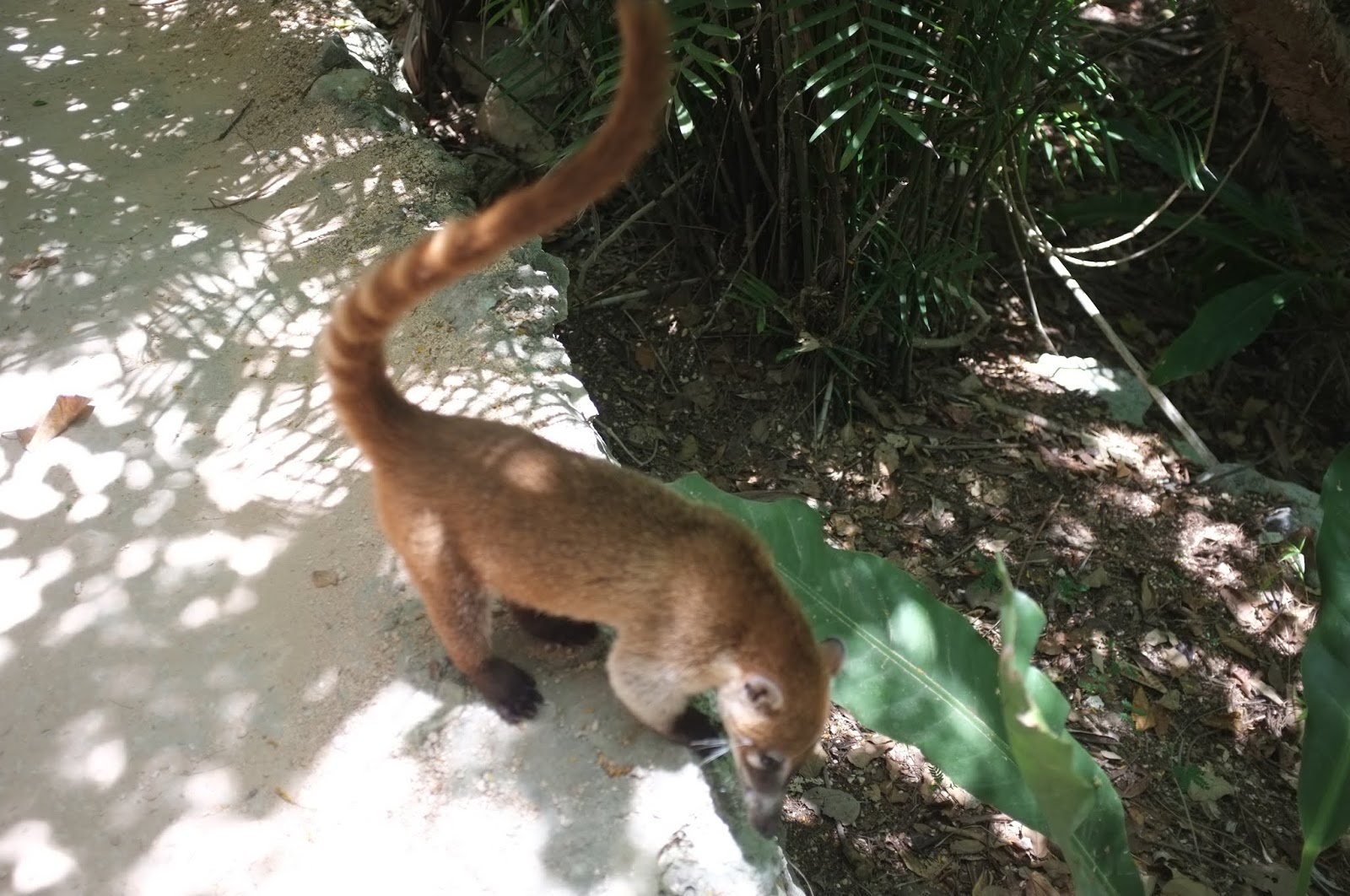

Mayan Raccoon Thing!

Like I said…picturesque.  Unfortunately, the 16,000 other people there that day also found it picturesque.  We spent half our time at the ruins stuck in pedestrian traffic jams at the primary points of interest and the other half running the gauntlet of selfie sticks. But this isn’t to say we didn’t thoroughly enjoy ourselves, and if you find yourself on the Yucatan Peninsula, it’s 100% worth the trip. Just go early in the morning to avoid the big crowds. Or start your day with some Indio, and then you just won’t care.
On our last night of the cruise, we went to the Svedka Ice Bar where they give you a neon poncho and send you into a freezer. Literally. Because aside from the TV (?) and the cocktail dispensers, most everything is made of ice: the bar, the art, the fixtures, even the glasses. Patrons are given 45 minutes to experience the coolth, but most don’t make it more than 20. The Captain lasted about 35 minutes before conceding that perhaps flip-flops were not the wisest of footwear choices, but the Deck Boss and I went the distance. Mainly because we got to talking to the bartender, but also because it takes longer to finish a cocktail when it’s in slush form. And if you were ever wondering at what temperature alcohol freezes, the answer is negative 10.
It’d been a long time since I was this cold. Or this fashionable.
We disembarked in Miami the next morning where we had to endure an hour at immigration and customs and another two hours huffing car fumes waiting for the shuttle that never did come before finally grabbing a taxi and arriving back at our hotel…thoroughly irritated, light-headed, and snapping at each other. You know, exactly how you want to end a vacation. But after some decent Chinese food and a drive around Miami to take in some of the sights, we felt much better.
Because nothing brings a family together like sniggering at the fashion fails of a complete stranger. Best laugh we had all week. And the longest. It took us 45 minutes to traverse four blocks in South Beach, which is approximately how long it took this guy as well. But then it’s hard to make good time when you’re wearing “hobble pants”.  
At this point, I’d like to send another shout out to American Airlines who chose to make up for the less-than-stellar flight to Miami by being complete jerks on the way home. How, you ask? Well, have you ever heard of a box ban? No? Neither had we. So, here’s the scenario… we don’t travel light. At least not on the way home. There are just too many things that we need for the boat (and for ourselves) that you just can’t find in Central America. So, we may have arrived in Miami with three carry-ons and two suitcases, but we returned to El Salvador with three carry-ons, two large “purses” (because you are allowed one carry-on and one personal item), a laptop, four large roller bags, and a welder. Yes, we are “those people”. We got to the airport two and a half hours before our flight; blew through the first hour of that waiting in the check-in line; then spent another 45 minutes at the counter trying to get the luggage sorted out. Because it was here that the airline rep took one look at the welder—snuggly packaged in a sturdy, square box—and informed us that “certain countries” are subject to a “box ban” during “select times of the year” and that they couldn’t accept our box. She claimed it was due to “weight distribution” but wouldn’t elaborate, so we were kind of left wondering what it is about late July in El Salvador that throws airplanes off balance, but in the end, it didn’t matter because there is no recourse when you’re already there and the flight leaves in a half hour. But luckily, the Captain had noticed a packaging kiosk right across from the ticket counter and dragged the welder over there. He purchased a square-shaped duffle bag for $40, removed the welder from the box, placed it in the bag, refitted the packing foam around it, and had the whole thing shrink wrapped. We now had a perfectly square bag the same size and shape as the original, but without the offending “box” portion. Good to go. Now while he is taking care of this, the airline rep is having me remove items from one roller bag to put into another so that all four are roughly the same weight. And this has nothing to do with one being grossly overweight while another is markedly underweight. This is just busy-work. Because even though I offered to step aside so she could help another customer while we were getting the welder repackaged, that’s not how American rolls. Because why inconvenience one person when you can inconvenience everyone? Besides, it’s a good way to shift blame away from American if everyone thinks you’re the a-hole holding up the line. All I can say is that it’s a good thing the Captain came back with the welder when he did because I think the rep was about to have the Deck Boss and I start swapping clothes so we would weigh about the same. Editor’s Note: In case you think I’m exaggerating, the woman at the counter next to us was trying to get her dog on an international flight without prior notification and without a health certificate. Instead of helping the next person in line while she got her shit together, the rep waited for her to call her vet, her husband, another vet, American Airlines customer support (?), another vet, her husband again, etc. She was at the counter when we first got in line and was still there when we left—almost two hours. I highly doubt that she made her flight. Which is probably a good thing, because I’m guessing Costa Rica doesn’t want someone that stupid traipsing about their country.
But our customer service experience didn’t end there! When we finally got to the gate, the airline reps stopped the Deck Boss and started grilling her about her carry-on bag (aka the TSA-approved one they had no trouble with on the previous week’s flight.) First, they said it was too big, but when they placed it in the metal “tester” stand, it fit perfectly—and it continued to fit perfectly even after they tried it sideways, face down, upside down, and on top. They then said there was no room on the plane, yet they didn’t say anything to me or the Captain about our carry-ons. Finally, they resorted to the old “the airline rules and regulations state blah blah blah” while wresting the carry-on out of her hands. That we saw it again on the luggage carousel in San Salvador is a miracle in and of itself. But you know what else we saw on the carousel? Boxes. Lots and lots of boxes. Box ban my butt.
On a positive note though, given our past experiences with El Salvador Aduana (customs), we were a little nervous about bringing so much stuff into the country but, as it turned out, we just breezed through the airport with all our luggage. Because apparently there’s nothing suspicious about three gringos coming into the country with three carry-ons, two large “purses”, a laptop, four large roller bags, and a welder.
As long as there are no cuticle nippers, it’s all good.

Friday, August 3, 2018

Day 697 to 782 of the Third Voyage: In which I try desperately to get caught up on the blog (which is made all the more difficult without the letters “ “, “ “, “ “, and “ “. )


Yeah, yeah, yeah. I know. I’ve been a little remiss in my blogging of late. Especially since I’m sure you’re all dying to know if El Salvador is really as dangerous and violent as they report in the news and if it truly is—as someone recently stated—a “shithole.” Well…we’ve been here over three months and so far haven’t experienced any violence or encountered anything I’d call particularly dangerous, but I have seen a shithole. Editor’s Note: If that doesn’t keep you reading, I don’t know what else will.

Most of the “bad hombres” (i.e. the maras or gangs responsible for most of the violence) run rampant in large sections of San Salvador, La Libertad, and other municipalities but, according to our friend Santos, the last two years have seen a decline of gangs in the countryside. This is not to say that all is peachy out here—tall walls, window bars, razor wire, and lots of security guys with guns are a constant reminder that the best offence is still a good defense (and doubly so in the city where the threat is greater and the guns are bigger.) Still, this does not stop the average Salvadoran from being friendly, outgoing, and genuinely helpful. I have never been in a place where someone will cross the street to exchange pleasantries, hold your groceries on their lap if there’s standing room only on the bus (which is frequently), or bring you coconuts and mangos simply because they thought you might like some and not because they expect something in return. They are truly kind and generous. That makes it all the more heartbreaking when you hear of how many are victimized and by the people in their own neighborhoods, because the gangs here are less about drugs and more about extortion and intimidation. At least in Mexico there was a code of sorts. Unless you were in a cartel, did business with a cartel, or hung out in cartel bars, got drunk, and picked fights with cartel members, you were reasonably safe. Here, a lot people are not safe—it’s a pay or die system in many communities —and most have little to begin with. In other words, the gangs here are just assholes all the way around. But I’m no expert. This is just my observation. Do I/we feel safe? Absolutely. We just won’t venture into certain areas or knowingly put ourselves in risky situations. Which is good advice for any place in the world really.

But that’s big picture stuff—and not to be taken lightly. I suspect you’re here for the more intimate snark.

So where are we?  We are about two hours by car outside of San Salvador on the Costa del Sol, which is a seven-mile peninsula in the Department of La Paz (a Department being the equivalent of a State.) The Pacific Ocean borders one side; the Jaltepeque Estuary borders the other; mangroves and palm trees grow thick throughout; volcanos loom in the distance. The nearest town is San Luis La Herradura, an hour and a half by bus or 30-40 minutes up the estuary by dinghy. The slightly larger town of Zacatecoluca is just shy of two hours by bus(es) and has a bank, a couple of grocery stores, and the only Claro office we know of with an English-speaking rep (which is extremely important when you’re negotiating a cell phone plan to get you through Central America.)


At first glance, there doesn’t seem to be much to Costa del Sol—just a two-lane road right down the center with tall walls on either side punctuated by tiny villages, road-side tiendas and the occasional food stand. But behind the walls—through individual gates—are resorts, private residences, businesses, restaurants, a large school, and public parks adjoining the beach. To maximize access to the water, the properties are all extremely narrow yet incredibly long—a good quarter mile from the road to either the ocean or estuary. We are in the marina at the Hotel Bahia del Sol—about a mile from the tip of the peninsula. It’s a nicely-run resort that caters to upper middle-class Salvadorans and frequently hosts large groups and company retreats so it’s not uncommon to stumble upon all manner of people engaging in “team building” exercises that run the gamut from three-legged races, drum circles and scavenger hunts to my personal favorite: drinking in the pool. Editor’s Note: Cruisers in general are very good at “team building”.

What sets this resort apart from the others is that they have property on both sides of the road, so the hotel grounds run the entire width of the peninsula—a good half a mile. The marina is located on the estuary side where there is a restaurant, bar, and a pool.  At the ocean end of the resort, there is another restaurant and bar and an even bigger pool.

Obviously this pool is 30° degrees cooler.

For the most part, we like where we’re at. For one thing, we’re getting a helluva good deal on moorage: $300 per month including electricity. Editor’s Note: Don’t feel bad for them. Yes, they’re losing money due to our astronomical electricity consumption, but are easily making it back in our weekly bar bill. How big is it? Let’s just say when we settled up last week, the guy at reception had to replace the receipt roll halfway through during which time he remarked, “You’re really enjoying yourself!” Six feet of paper later, we’re paid up and leaving and he calls out after us, “Continue to enjoy yourself!” Which is probably hotel-speak for we just covered his salary for the next two months.

Suffice it to say, we frequent the restaurant/bar at the hotel a lot. This is mainly because while there are a lot of restaurants around, none are really within walking distance. Editor’s Note: I should clarify that none are within Deck Boss walking distance. Although in her defense, the closest is over a mile away and we are in the tropics, so it seems more like ten. With a distinct lack of taxis out here, the alternative is chicken bus or dinghy. And as you know, the Deck Boss doesn't do chicken buses and (new rule) will only do fair-weather dinghying. Why a new rule? Every Sunday, a couple of expats host a potluck at their house which is located a few miles up the estuary by dinghy. The last time we went, the return home was not very pleasant (which is a more genteel way of saying it was super shitty.) A rapid outgoing tide clashed with a brisk incoming wind which created small whitecap conditions which are doable on a larger watercraft, but not so much when you’re practically in the water to begin with. We had two choices: fast or wet. Fast would entail trying to plane on top of the waves which would result in an extremely bumpy ride. Wet was slower, but took hip breaking out of the equation. So wet is was. And very much so. The Deck Boss was not happy and gave her customary “Never setting foot in the dinghy again!” proclamation. It took several days, extremely calm weather, and the promise of her very own bucket of beers to get her back in the dinghy, and only to a place that was less than five minutes away.

You may have guessed by now that Bahia del Sol is remote. And you’d be right. Shopping is more of a challenge here. The nearest tienda is about half a mile away and stocks soda, beer, snacks, and a smattering of assorted household items. Basically, it’s geared toward the holiday goer who’s craving a bag of Cheeto knock-offs and the vacation-home owner that forgot to pack napkins. But we like our little tienda. They almost always have eggs, sometimes have bread, and occasionally stock fresh produce or can procure some when the farm truck goes by. 
But there's free WiFi!


There is a Supermercado about 30 minutes by chicken bus up the road—literally in the middle of nowhere. It looks like a modern grocery store, has all the trappings of a modern grocery store, and never has anything you need outside of liquor and mayonnaise. It, too, is obviously geared toward tourists and the vacation-home owner that forgot to pack the cocktail olives because they have flip flops, six different kinds of snack cracker, and weird “party pack” combos (like a two-liter bottle of Coke, a plastic shovel, and a sponge), but not anything of real nutritional value. It does, however, have the world’s fastest ATM. Unlike a typical ATM that buzzes, whirs, shuffles, and has to seriously think about whether or not it really wants to give you money, this thing practically spits bills at you halfway through entering your pin. I guess it doesn’t want to impede on your shopping time. After all, those Vienna Sausages aren’t going to buy themselves.

He ran out of mayonnaise.  And flip flops.

We do our major provisioning in San Salvador where there are Walmarts, Super Selectos, and PriceSmart (which is the Costco of Central America.) We hire Santos for the day and he drives us to doctors appointments, pharmacies, and pet stores. Fun fact: kitty litter gets harder to find the further south you go and even though western-style pet boutiques are springing up everywhere, many have mastered the art of small-dog leisure wear but still can’t fathom why you’d let a cat shit indoors. (Which now that I look at it written down, I can’t fathom either.) Anyhoo…when you find it, buy it all. It’s like gold on the black market. We finish the day provisioning at the large grocery stores which we then supplement with trips to Supermercado and the grocery stores in Zacatecoluca where the stores are decent enough, but you must be prepared to schlepp everything back on the bus. And speaking of…

Unlike Mexico where most of the buses are old touring coaches that are way past their prime, the chicken buses here are tricked-out, repurposed US school buses (and have the original shock absorbers, brake pads, and gum under the seats to prove it.) Each is customized with paint jobs, decals, and stereo systems. Some have mood lighting. Others have fins and spoilers. All come with a very loud horn that you can hear from a mile away to let you know they’re coming. But not a “toot toot” horn. More of a “freight train hurtling down the tracks at 90 mph going to mow you over so get out of the way” horn. Only they don’t want you to get out of the way; they want you to get on.  Because each bus also has a wrangler whose job is to get people on the bus, get them seated and/or squished in the aisle quickly, get them off even faster so he can get more people on, and collect fares. To do this, he is constantly moving around from the front door to the back door, down the aisle, and around the outside, communicating with the driver the whole time through shouts and loud whistles and by banging on the sides. In between stops, he weaves through the crowd shaking a money bag and collecting fares. When the bus is packed, he’ll stand on the lowest stair and hang on to the side-view mirror to make room for the people who are squeezed up against the windshield because that “Do not stand forward of the white line” sign that’s left over from its days as a school bus is now just part of the “American kitsch” decor, as is the “maximum capacity” number. I’m really surprised that no one has thought to put in luggage racks because they could easily fit in another 35 people right there. Although they did take a cue from the airlines and install the seats closer together because four inches in between rows is all anybody needs, right? At least that way the seat bottom—which has inevitably broken off its frame—doesn’t have far to slide.  But in spite of it all, I like the chicken bus. It’s always an adventure and it really is the best way to see the countryside (at 90 mph) and get close to the people (really close to the people). 

Pictured: The back of a typical bus.
Not Pictured: The front. I didn’t want to get run over. An action photographer I am not. 


In case you thought I was exaggerating about the legroom. Upon closer inspection, I think I was being generous.


View of a city bus in San Salvador as it races through an intersection. And yes, that is a picture of Popeye wearing a wife beater and holding back two snarling rottweilers. Because why not? Now get on!!!


Not to be outdone…


Suffice to say that given its remoteness, we spend a lot of time at the resort, which is okay because there’s a lot of work to be done. We came to El Salvador with a healthy list of boat chores—and that was before the debacle now known as “The Journey Here” added a good page of additional projects. So mornings are spent working and afternoons are spent recovering from heat stroke. Editor’s Note: I won’t bore you with how hot it is here.  If you want to know, simply reread the previous blog posts about the heat in Mexico, imagine it a smidge moister, and then add more bugs.

Never get up to use the head at three in the morning. You don’t know what’s lurking out there. It took me three days to get up the courage to see what I had trapped. The Captain said it was a cicada, but I’m going with big, black beetle of death.


The marina itself is of the old wooden dock variety. Shoes are a must to avoid splinters and it’s best to walk straight down the middle because pangas like to zoom through the estuary at Mach One speeds and create such wakes as to cause the docks to buck and bounce and all the boats along with them. The incoming and outgoing tides create huge currents that run as fast as a river a couple times a day, flushing out the estuaries and sometimes necessitating the unsticking of a palm frond or puffer fish out of your fenders. But overall, the docks are safe, regularly maintained, and the power is better than some of the fancier marinas we’ve stayed at. We also have security guards that patrol throughout the day and sit out on a chair in the middle of the dock at night. There are no crime issues here that I’m aware, but I’m sure the marina wants to protect its investment. Nothing keeps a resort going during the slow months better than hot, thirsty gringos.

Really the biggest drawback to our current home base is that it’s not very Otter friendly. What was wonderful about Barra was that there were lots of back roads and large fields for him to run around off leash, a lagoon to frolic in, and dog-friendly restaurants throughout the town where the proprietors knew to bring him a beer because he was the “perro de que le gusta la cerveza” and travelled with his own collapsible bowl. Barra was pupper heaven. Here not so much.

Obviously, he must be kept on leash while on the resort property. Fair enough. Except that even off the property--although we’re out in the middle of nowhere with long stretches of open road--I must keep him on a leash. The problem is all the street dogs. There were street dogs in Barra but, with some exceptions, they pretty much kept a low profile. I guess when you’re reliant on handouts, you don’t want to be “that dog” that starts trouble and gets fed the “meatball” (which is as ominous as you probably think it is and not just because it’s in quotes.) The difference here is that there aren’t a lot of places for them to get regular handouts, so they roam around the vacant properties, rummage through the garbage for food, and tend to be extremely territorial. The resort tries to keep them off the grounds, but they like to congregate under an old palapa at the head of the beach where they sleep under lounge chairs, dig holes in the sand to stay cool, and hope that one of the tourists will drop a Cheeto knock-off. So every time Otter and I want to go to the beach, we must run the gauntlet of these barking, posturing flea bags. Yelling and stamping will keep most of them at bay, but if the alpha is around, a big stick is necessary to let him know that I mean business. Some suggested I carry pepper spray, but I haven’t been able to find any, so if it gets any worse I may resort to carrying a squirt bottle of Fabuloso household cleaner. A couple of shots of lavender-scented degreaser should confuse them enough to let us pass by. (That and it would help with the smell.) Once well past the pack, Otter can be off leash and play in the surf, but I must always be vigilant of any dogs that may be roaming the other properties. It kind of turns “relaxing stroll on the beach” into “keeping your finger on the trigger and an eye out for Charlie”. 

“I’d be nice if I surfed. Maybe then I could drown some of these fleas.”  


But I must admit that I do feel sorry for them. They’re all skin, bones, ticks, and fleas held together with six layers of dirt. They may not have any natural predators on the peninsula, but undernourishment is doing just as good a job at keeping their numbers in check. It’s a tough life, and I am sympathetic to their plight, but make no mistake, I will drop kick one into next Tuesday if it messes with my dog. Part of me wants to start bringing dog biscuits so that they have something to eat besides garbage (and perhaps come to think of Otter as the “provider of food that isn’t three-day old fish skin” and maybe quit giving him such a hard time), but then I don’t want to become the pied piper of the perro and wake up one morning to find half the street dog population gathered outside our boat waiting for their daily Snausage.

But street dogs aren’t the only reason Otter must be leashed at all times. There are also quite a few feral cats on the property that enjoy teasing him, innately aware that he can’t get too close while I have him harnessed up like a farm horse, only now they have upped the ante by giving birth to sizable litters. Evening walks entail pulling him past tiny little furballs that think they’re rearing and hissing but look more like they’re yawning and stretching which only makes them cuter. Part of me wants to start bringing them cat food, but that would inevitably lead to adopting the lot of them and Otter already has one cat at home that likes to kick his butt on a regular basis.

Off the property, temptation lies in the form of goats, horses, lizards and, his new favorite…cows. To him, cows are just big dogs. Except that he can bark at these dogs and instead of barking back, they’ll follow him along the fence until they can’t follow any further and then look on confused as I drag him away. We’re lucky we’re not further up the peninsula where the cattle roam free along the sides of the road or I’d spend half my time trying to return cows to their rightful owners, because apparently cows aren’t too bright and will follow anyone or anything that sounds vaguely authoritative.  

Don’t honk at him. He’ll follow you home.


Oh…so you’re probably wondering about that shithole part of the country?  So out here in the estuary they have what are known as “stick restaurants” and if you’re guessing it’s a restaurant built on wooden pilings in the middle of the water, then you’re spot on because…

The Hooters is next door. No, really.

Unlike its counterparts in New York, London, and Hollywood, the Hard Rock Café here is devoid of kitsch, pretension, and walls. In it’s place, are mismatched plastic tables, hammocks, and a complete disregard for building codes (and copyrights for that matter.) There is a makeshift kitchen, a refrigerator lying on its side for maximum beer storage, and a generator to keep the fridge going. Seafood is the specialty. A lot of times there is no menu. They simply bring out a tray with the day’s catch on it and you point to what you want and tell them how you’d like it prepared. The sides are simple: rice, dried fruits, etc. And the beer is plentiful. In fact, it’s too plentiful. Which is typically when it hits you that a place on stilts in the middle of an estuary with a makeshift kitchen and a fridge lying on its side is probably not going to have running water let alone “proper facilities”. And you’d be right. What they do have is a small walled-in area behind the fridge with a shower curtain for a door and a couple of missing floor boards. No sink, no toilet, no paper, no instruction manual.

 Toto, we’re not in Kansas anymore. If we were, there’d at least be a corn cob to wipe with.

General consensus about the Hard Rock Jaltepeque:  The ambiance is fantastic, and the food is obviously good—you’re seriously not going to get any fresher than “just caught”—but I spent the rest of that afternoon living in fear of my bladder. Although I must admit, the “bathroom” here was cleaner than the one in Vegas.

Time to tie this back in to the title…

I apologize for the shortness of this post. There is much more to be said, and I will get there eventually, but I am experiencing severe technical difficulties that have turned the blog-writing process into a monumental chore. Namely, the “t” key only works sporadically and the “b” key quit working altogether on my Mexican laptop (I’d say that this was another case of “Mexican’t” except that my last laptop also developed a keyboard problem. So either I type weird or the universe hates my blog and wants it all to stop.) Now obviously, there are “b’s” in the above text or I wouldn’t have been able to type “obviously” but in actuality, I have to type “oviously” and hope that spellcheck finds and corrects it. You’re just going to have to trust me on this one. Spellcheck trusts me…trusts me to be a big friggin’ idiot who can’t spell. Obviously.

Editor’s Note:  As of this writing, the “f” and the “r” have ceased to work and the “n” is on its way out. The “4” aka “$” conked out long ago. I guess if I ever need to use the words, “eoe”, “ae”, or “oa”, I’m uckig screwed.

Sunday, April 22, 2018

Day 693 to 696 of the Third Voyage: In which I have to ask, “How many times must you get hit by a boom before it knocks some sense into you?”


I’m not a sailor. I didn’t grow up around boats or spend that much time in or around the water. I didn’t get on my first sailboat till the Captain bought a 16’ Razor and took me out on Lake Washington. That first outing lasted a grand total of 15 minutes. We headed out, he went to tack, the boom hit me square upside the head, and before he could tell me to duck, it swung back around and hit me square upside the other side of my head. I demanded he take me back to shore. It was six years before I stepped foot on another boat.

Where am I going with this? Strap on your life vest, this here’s quite a story…

We left Puerto Chiapas at 4:00 pm on April 14th with an anticipated travel time of 42 hours. The timing had to be perfect as the only way to get to Bahia del Sol in the Estero Jaltepeque in El Salvador is via a very nasty bar. Editor’s Note:  In this case, a “nasty bar” does not denote a sketchy watering hole where you might get your ass kicked. Here, it refers to a large sandy obstruction between two bodies of water. Of course, you can also get your assed kicked there too.  At any rate, it’s only “open” during slack tide and it requires the assistance of a pilot boat that guides you over the bar via radio instructions. Our window was between 3:15 and 3:45 pm on the 16th so, barring any (ahem) complications, we had planned to be near the mouth of the bar that morning where we would anchor for a few hours and wait for the pilot.

The first 30 or so hours were 90% awesome. There wasn’t any wind, but the seas were smooth, the skies were clear, and the engine was purring. The night watches went off without a hitch, and the Deck Boss did her first-ever solo shift the following morning so that the Captain and I could get a few more hours of sleep. The only part of the journey that wasn’t so awesome, was that neither the Captain nor I could stomach any food. Maybe it was nerves or maybe we got into some bad shrimp at lunch, but he had zero appetite and I couldn’t keep anything down.

A few hours before dawn on the morning of the 16th, the engine began to do that old ditty of rev down/rev up only this time it added a new refrain of rev down/rev up/rev down/die. We tried keeping it at a lower RPM; it would die. We tried switching the fuel tanks; it would die. We tried polishing the fuel; it would die. We tried switching out the Racor filters; it would die. The Captain even tried installing a secondary fuel pump, but I think you can guess the outcome. We finally gave up on the engine. All we could do now was hope we could keep some wind in our sails, but as the old adage goes (and apparently it only applies when things are crappy), “Be careful what you wish for.”
Pictured: Our first glimpse of El Salvador right before we wished we hadn’t wished for anything.

Just as the sun was rising and the coast of El Salvador came into view for the first time, our steady winds of 6-8 mph steadily increased to sustained winds of between 25 and 30 with massive gusts that sent the needle over 40, and our flat seas suddenly turned into 8’ rolly waves that pressed right up on our bow, slowing our speed, and pushing us off course. It required constant trimming and constant correcting. In addition, we were taking water over the bow and into the cockpit, because there’s nothing like a face full of salt water to remind you who’s in charge out there.

This went on for a couple of hours and then as quickly as it had come up, it went away. A couple hours after that and it was all gone—no wind, no waves, not even a current to help us along. And that’s how we found ourselves about 18 miles from the anchorage, racing along at a blistering 1.5 knots. With only four hours till our bar crossing appointment with the pilot, it was becoming very apparent that we would miss our window. Now by this time, the engine had been caput for about eight hours, and even though we were trying to conserve power by shutting off all non-essential items, the house batteries—without the engine to charge them—were starting to get low. No problem. The generator can charge them! So we went to start the generator and instead of that comforting rumble we normally hear when it comes to life, we got, “click, click, click” instead. Because of course—OF COURSE!—the 12-volt starter battery had not charged up properly when we were last plugged into shore power and was obviously not drawing enough power from our solar panels to make up for it. And here’s the stupid part…whoever installed this thing in the first place (not us), thought it would be a good idea to have this one battery not only start the generator, but run all the sailing instruments as well. So we immediately started turning off all pseudo-essential items to save the house batteries and as many 12-volt items as we could to keep the instruments going. So, let’s recap…no engine, no generator, waning batteries. Oh…and the Captain’s lack of appetite has, by this time, crossed over into liquids as well, so now he’s fatigued, cramping up, and exhibiting other signs of dehydration. It didn’t help that he also spending copious amounts of the time in the engine room/sauna. In the meantime, I’m still throwing up everything I eat, including the anti-nausea pills, and this has caused the “hurling domino affect” and now the Deck Boss is spending quality time hunched over the head.

We got on the VHF to try and raise anybody at Bahia del Sol but must have been out of range because we couldn’t hear anything. Luckily, another sailboat, S/V Illusion, had broken down in the anchorage just outside the bar (okay, so… lucky for us, not for them.) and they were able to relay our messages to the organizers of the El Salvador Rally. Within 45 minutes, Bill arrived in a panga with Steven, a fellow cruiser/nurse, to do a wellness check and bring us some cold water, juice, and charged-up VHFs. Unfortunately, we were still about 14 miles from shore, too far out for the panga to tow us in. Bill and Steven suggested that the Deck Boss might go back with them to Bahia and I jokingly replied, “No, she wants to go down with the ship.” Editor’s Note: Remind me to keep my mouth shut. I think we put on a brave face, but it was a sad sight seeing them go. Bill had suggested that we hip tie the dinghy and use that as our “motor” so that’s exactly what the Captain and I set about doing once they were gone. And for about an hour and a half, as we chugged along at 2.8 knots with our little dinghy deftly propelling our 66,000 lb. beast through the water, we were hopeful that we might make the anchorage sometime before midnight and maybe even get some sleep. By this time, our battery bank was extremely low, so we shut off absolutely everything except for the sailing instruments, autopilot, and navigation/steaming lights to conserve as much power as we could.
Pictured: Our brave little dinghy powering us through water.
Not Pictured: The knife it had stowed under the seat in case it had to save itself.

And then of course—OF COURSE!—the wind came up, and up, and up some more. And with the wind came waves and the dinghy started to get caught up in the side swell. And when it threatened to flip up onto its side, we untied it and secured it via a line to trail behind us. At this point, with the sun setting, the wind and waves picking up, and us in the precarious position of being pushed toward an unfamiliar shore to anchor in the dark sans motor, we decided our best option was to just sail through the night and try again when it was light. We pointed the bow south and off we went. By this time, it was pitch black out, the wind was howling, and the boat—which was getting hotter and stuffier by the minute down below—was pitching back and forth. It was a bumpy, uncomfortable ride. Then, one hour in, we saw on the charts that we were coming up on some shoals. We would have to tack and tack hard. The Captain asked me if I wanted to steer or handle lines, and since I always tend to oversteer when I’m nervous, opted for the latter. So I knelt behind the two winches (we were rocking too hard to stand) and got ready to release the one line and start cranking on the other. And we started the tack. But instead of the sail moving smoothly from starboard to port—and the boat moving with it—everything suddenly stalled at the halfway mark and the sail started to flap wildly, then fold over on itself, and the Captain tried cranking the wheel as hard as he could and that’s when he realized…we had no steering. The whole boat started to heel heavily to starboard. He quickly went aft and manhandled the lines to get the jib back into place and us upright. So here we were…no engine, no generator, no steering, no lights or electricity down below, it’s blowing like stink, and we have no idea how we’re going to turn around. We had skirted this group of shoals via the bad tack but now we were headed out to sea (aka nowhere) and had no idea what lay ahead. We decided it might be time to call for help. We tried to raise Bahia del Sol on the VHF but were too far out. We tried to raise the El Salvadoran Navy (if there is such a thing) but got nothing. The Captain sent me below to apprise the Deck Boss of the situation and get the flare gun while he checked the EPIRB. If we came up on more shoals and had no way to steer clear­, we needed to be prepared for the worst.

And as I was pulling the ditch bag out of the wet locker, checking the flare gun, and readying Otter’s life vest and Edgrrr’s carrier, a weird feeling took over. I wasn’t scared. I wasn’t even slightly panicked. Instead, I was concerned as to what would happen to Raven if the situation did ultimately call for a rescue. Would they try to tow her? Would they sink her? Or would they just let her drift out to sea? Never having been in this situation, I didn’t know the protocol and the thought of abandoning her really depressed me. Because even after all the problems we’ve had with Raven—and they’ve been considerable—she’s part of the family. Not just a home, or a mode of transportation, but an actual member of the family. Like a living, breathing thing. Granted, she’s the relative that you don’t talk about at family reunions because she’s always in and out of rehab and just can’t quite get her shit together, but you’d never begrudge including her on the Christmas card. In short, she may be a hot mess, but she’s our hot mess. And I’ll be damned if I’m going to let anybody sink her or send her off to die. There had to be another way.

I went back up on deck to talk to the Captain about it and found him laying down on the cockpit cushions, as if about to take a nap. In truth, I was taken aback—I was expecting a sense of urgency and a lot of running around, but instead it was like time had slowed down and maybe this was all a dream after all. In actual fact though, he had tweaked his back during the disastrous tack because why just have a dead engine, a dead generator, dead steering, dying batteries, and dehydration when you can add some acute back pain to the deal? But I think lying down, looking at the stars, and trying to ignore the spasms gave him some time to think, and by ultimately disregarding what didn’t work and instead focusing on what did work, he came up with a plan. Namely, we would continue on our current course as best we could using whatever influence the autopilot still had over the rudder and just hope that if we had to tack or gybe, that we’d be able to do it in five to ten click increments. (As it turned out, we did have to execute one gybe to get us turned around and heading north and a couple of “pseudo” tacks to keep us in the wind. They were sloppy—but successful.) Needless to say, it was a long night. The Captain and I, both dog tired by this point, set 10-minute timers so we could keep an eye on our course, sails, and any obstructions. And although the wind did finally quiet down around one in the morning, what followed was unsettling in its own way. Namely, without the usual background hum of electric lights and gadgets, the boat was so silent that you could hear every creak and groan and feel the mast shudder with every movement of the boat. I’m pretty sure we were all thinking the same thing—that perhaps the mast was getting ready to fail too, because why not?—but no one dared to say it aloud.

At dawn—nine hours after we lost steerage and 24 hours after we lost the engine—we found ourselves in pretty much the exact same spot—14 miles out from the bar entrance—where Bill and Steven had met up with us in the panga the day before. We hobbled along—averaging about 2 knots—and thought of doing another hip tie with the dinghy but we were too far out and didn’t know if we’d have enough gas. That, and we were too scared to look behind us and see if we still had a dinghy left. Editor’s Note: We did. But the line had become so frayed in all the ruckus that one or two more good waves would have snapped it in half. Why it didn’t is anybody’s guess. Maybe it’s waiting to go when the mast does?

But ultimately, we did make it to the anchorage and as soon as we hit 40’ of water, let the anchor fly. With only enough electricity to run one thing at a time, I would pause the windlass long enough for the Captain to use the bow thruster to keep us in place, and thus it went until we had enough chain out. When it came time to back down on the anchor, the Captain tried the wheel as he was leaning on the thruster, and the steering answered. Apparently, whatever had caused it to seize up in the night—most likely an air bubble in the hydraulic hoses—had worked its way out. Either that, or it felt sorry for us. Wish the engine, the generator, and the batteries felt the same.

Now here’s where the story gets good. And by good, I don’t mean things got worse. This time, I mean some good stuff actually happened. It turns out that all those distress calls we’d been sending were getting through, it’s just that nobody was able to get through to us. (That, and apparently there is no El Salvadoran Navy.) So by the time we finally hobbled into the anchorage, our friends in the Bahia cruising community had already lined up a mechanic, a portable generator, water, ice, and cheeseburgers and dispatched them all via panga to meet us. While fellow cruisers Eric and Greg helped us prepare for the bar crossing, Willy the mechanic and his crew worked on the engine. After about 30 minutes, he was able to identify our primary problem. Two of the bolts in our bleeder valves were stripped of their threads and that in turn had caused a massive vapor lock. This wasn’t something that could be repaired right off so as a quick fix, they got our engine going by feeding it diesel directly from a barrel, bypassing our fuel system altogether. It was enough to get us over the bar, and that’s all that mattered.

As for the bar? The crossing itself turned out to be uneventful, yet it was extremely meaningful. We were all in the cockpit when we went over the bar—even Edgrrr—and I must admit I got a little choked up. This had undoubtedly been the most difficult journey we had undertaken thus far, but we made it through as a crew, as a family. No one panicked, no one dropped the ball, no one even raised their voice or got snippy. We worked together as a proper crew should. And despite everything that happened, Raven did her job—she got us here in one piece even as she herself was broken. It was, I felt, a huge accomplishment. And when we got into the marina, there were probably 20 people waiting to cheer us in. It was overwhelming. It was humbling. It was a total rollercoaster of emotions. If I hadn’t had to go immediately to Customs and Immigration, I’m pretty sure I would have locked myself in the head and cried.

That was a few days ago, and I’m still somewhat numb from the experience. We’re almost caught up on our sleep; we’re eating again; God knows we’re drinking again; and that which was stowed is being unstowed. We’re here for at least six months. Got to get the engine fixed. Got to get the generator fixed. Got to sort out our batteries. Got to sort out our future. But this experience has given me a lot to think about. When I got double-tapped by that boom 20-odd years ago, I learned one very valuable lesson. Sailing can be painful, uncomfortable, and certainly dangerous. Perhaps other, more experienced sailors would have thought our little “adventure” a minor one; but for us, it was a huge deal—our first real foray into “here there be monsters” territory where the hard choices must be made. But I don’t think we did anything wrong, and I don’t think we needlessly put ourselves in jeopardy. We will do some things differently next time—extra communications, for one—but we’ll get back out. And maybe it will be better. And maybe it will be worse. But sometimes there’s not a lot you can do about it, except hold fast and see where the boat takes you. Because inevitably that boom is going to knock you senseless, and the best you can do is duck before it comes back around. And if it gets to be too much, there’s no shame in heading back to shore.


Postscript:  I realize that this was one of my more serious posts. In an effort to lighten things up a bit, here's some sophomoric humor:
Boobies!


Saturday, April 14, 2018

Day 679 to 692 of the Third Voyage: In which we spend our last two weeks in Mexico…assuming we can get out of Mexico.


Upon our arrival in Puerto Chiapas, it was time to bid ABS Brian an “au revoir” which is apropos for someone born in Quebec as well as a classier way of saying, “See ya later, alligator!” We will see him again because he is now officially part of the Raven crew (he’s on the Meet the Crew Page and everything!) and will join us on the next leg of the adventure when we leave El Salvador for points further south. This is, of course, contingent on us reaching El Salvador. But we are hopeful. Because truth be told, had it not been him, there’s a good possibility that we would have turned around and gone back to Barra. His sound guidance and staunch optimism during the typical Raven parade of problems, gave us the boost of confidence we needed to get this voyage back on track.

After a while, crocodile!

The day before he left, we thought it might be nice to find a beach front restaurant where we could dip our toes in the surf, imbibe in some local seafood and cold libations, and give Brian a proper send off. Unfortunately, it was Semana Santa (aka the week before Easter and a major holiday when EVERYONE in Mexico heads to the beaches, and those who don’t, go the week after) and the whole area was wall-to-wall with humanity. The marina manager got us a day pass into one of the oceanside hotels that, despite being a lovely ocean-front property with a very nice palapa restaurant, was unfortunately suffering from a bad case of “Too many guests and none of our waitstaff showed up” as evidenced by one lone server trying to juggle ten tables and failing miserably. Given that he was wearing what looked awfully like a bellhop uniform, we surmised that he was recruited out of the lobby when they found themselves short staffed. Luckily for us and the 40 or so other thirsty/starving patrons, he was eventually joined by a woman who was most likely making beds and cleaning bathrooms about thirty minutes prior and a random teenager who probably got bored and wanted to ditch the folks for a while. The beer was warm, the food was “meh”, and the whole ordeal lasted way longer than it should have. By the time lunch was over and we headed out to the beach, it was late afternoon which meant the sand was about 280 degrees, the surf was breaking higher than a small semi, and the riptide was strong enough to drag said semi out to sea. Not quite the send-off we were hoping for, but we did rectify the situation by going to Baos later that evening. Baos is a high-end restaurant on the marina property that serves fancy food such as grilled fish propped up to make it look like it’s still swimming, prawns (with heads still attached) arranged in a little stack like they’re playing rugby, and in a strange case of “seriously?” the first (and only) time we’ve seen New England clam chowder on a menu in Mexico (although it was quite good.) Unfortunately, it all comes at near-gringo prices, but we’ve been scabbing their Internet the whole time we’ve been here, so I guess that makes us about even.

The next day, ABS Brian left for Puerto Vallarta and the Captain went with him because in return for six weeks of his time to help us get this three-ring circus south, the Captain offered to help him paint his deck and do a few projects on his boat. So naturally, once the Captain was on the other side of the country, everything went haywire. It started quite suddenly when a very loud, very insistent, beeping-type sound erupted from the control panel accompanied by a flashing red, “I mean business” light right above the toggle that says, “Bilge Pump 1” on it. As the shot glass was still in place over the switch, I knew this was not Edgrrr’s doing (see Day 566-596 of the Third Voyage)this was the real deal. The bilge had filled up enough to trigger the second lever. Editor’s Note: When you look into the infinite blackness that is our bilge, you can see three levers that look kind of like foot pedals (well…hopefully you can see three levers.) When water in the bilge hits the bottom lever, it activates Bilge Pump 2 and releases everything via a through-hole on the port side—standard stuff. If the water rises high enough to active the second lever—Bilge Pump 2—it spews out of a hole about half-way up the freeboard on the starboard side—not so standard. Now if the water rises enough to reach the top lever, I’m not sure but I think the boat shoves a bucket at you and tells you to start bailing.

Now here’s the thing about our bilge. If you’ve kept up on the blog, you’ll know that we we’ve been having some “mechanical challenges” of late (and no, these are different from the “mechanical challenges” we had last year albeit similar to the ones the year before that and in any case should not be confused with our electrical, plumbing, and standard equipment “challenges”… unless you think this is about the transmission in which case, yes, these are the same “challenges”.) But back to the bilge: the transmission had leaked/ejected/vomited a lot of oil in the past couple of months and it had nowhere to go but into the bilge. And as we’ve been at anchor for most of that time, we have not been able to address it (i.e. get down in there to pump it out into large buckets for disposal) so it’s pretty mucky. So when Bilge Pump 1 went off, it blurted all that inky, yucky mess out the starboard hole all down the side of the boat and all over the dock. And still the alarm was going off, so I called the Captain who instructed me to go into the engine room, find the wires that attach to the bilge pump, and jiggle them around. Now what he failed to mention was that jiggling the wires would cause the bilge pump to go off which is quite disconcerting when you’re precariously balanced over engines, transmissions, water pumps, hoses, and all manner of scary looking things and suddenly this hunk of metal jumps up, rumbles, and makes the loudest racket you’ve ever heard. Heart attack number one, but the incessant beeping did stop. Next order of business was to clean up the oil before it stained everything and/or became an environmental hazard. So I got out the scrub brushes, the dishwashing liquid, the bilge cleaner, and everything else I could think of and went to get the hose, which was currently attached to our deck-wash system. What anyone failed to mention was that the deck-wash system had not been turned off so when I went to remove the hose, the pressure caused it to pop out and I took the full force of the water right in the kisser. Wasn’t expecting that, thus heart attack number two. I called the Captain to find out how to turn it off and consequently ended up on my belly on the wet deck reaching far into the anchor locker to access the world’s worst-placed faucet. I finally got the hose, threw it onto the dock, and went to attach it to the dock-side water. That’s when I turned around and found that Otter had followed me down, trekked through the sludge, and was now running all over the boat leaving inky paw prints in his wake. Heart attack number three. Two hours later and the mess was gone. An hour after that and so were two White Russians and an entire bag of Snickers. I continued to have problems with the bilge the entire time the Captain was gone. And then of course—OF COURSE!—as soon as he got back, the bilge fell silent. I suspect he thinks I may have made the whole thing up. I’m also beginning to suspect the boat is gaslighting me.

At any rate, while the Captain was gone, the Deck Boss and I got the lay of the land. Marina Chiapas is very nice—only a few years old—and, despite having sustained some damage from the tsunamis caused by last year’s earthquakes, is in excellent condition. Easily one of the nicer marinas we’ve been in. It’s also kind of an anomaly in that the rest of the area is very rural. The primary industry is agriculture as opposed to tourism so there aren’t a lot of gringos around and the tourists that do flock to the beaches and the handful of ocean-side hotels are locals and Guatemalans. The marina was obviously built to not only attract the pleasure boat traffic entering/leaving the country, but also to complement the new cruise ship dock they have built in an effort to bring in more tourism dollars. Until then, the area is very much working Mexico—a nice change from the ports up north.

There’s also a pronounced navy presence here—both marine and aviation. It’s to be expected given that we’re only 15 miles from the Guatemalan border and that Mexico has a (cough) slight problem with the trafficking of illegal drugs and weapons. Therefore, all boats that enter the port are subject to a search before you’re even allowed to get off your vessel—regardless if you’re coming from the north or the south. They arrive in the marina—mostly by panga, but sometimes by bad-ass 4x4 truck—and descend upon your boat en masse. One guy guards the Navy vessel, two guys with automatic rifles take point around your boat, two guys search your boat with a sniffer dog, and one guy handles the paperwork. They’re quick, efficient, and they’re deadly serious. But they’re also quite genial and will smile warmly, even as their fingers remain on their triggers at all time. We will get to go through this again when we leave. But we don’t mind. They’re fighting a losing battle—the majority of military-grade weapons are smuggled in via the Guatemalan border, but most of the resources to fight the cartels are sent up north—so whatever we can do to make their job a little easier is really the only way to show them a little appreciation for what has to be one of the more suckier jobs on the planet.
Gracias, Amigo!
If there was a drawback to Marina Chiapas, it’s that it’s quite a hike to civilization. The nearest town is Puerto Madero, over 5 miles away; the nearest city is Tapachula, about 20 miles away. There are local taxis, but they won’t go further than Puerto Madero (necessitating a change of taxi to continue further), the drivers are very “business-like” (a more diplomatic way of saying “abrupt”), and some will try to take advantage of the tourists. We made the colossal mistake of not verifying the price with one driver before taking a taxi to Puerto Madero and he tried to charge us 300 pesos for what is normally an 80-peso trip. To add insult to injury, he stopped for gas on the way there. The Tapachula taxi drivers are a little more accommodating and much more personable, although the ones going into the city don’t like to make the trip until their car is full. The Deck Boss and I had to wait a good 20 minutes in the afternoon heat until our driver could wrangle a third passenger. And even then, we stopped to pick up a fourth person along the way.

Pictured: One of the “nicer” local taxis. He didn’t have to stop for gas. That sweet, sweet spoiler gives him at least an extra one to two miles per gallon.

The best way to get around—as in most places in Mexico—is via collectivo. We used them all the time in Nayarit, but nothing prepared us for the Chiapas drivers. They weave and bob and pass through traffic at 110 mph (or maybe it was only 95—it’s hard to tell when the speedometer is broken. And they’re ALL broken.  Needle fatigue I’m guessing.) Up north, we were in one that cut through parking lots, the collectivos here simply cut through oncoming traffic. It’s not for the faint of heart. Nor for someone who doesn’t like “togetherness” because the vans may be designed to hold 12, but we counted no less than 18 people on two separate occasions. One collectivo posted a sign admonishing people not to stand on the seats. Apparently, this guy realized that he could fit more people by stacking them in like firewood and therefore save the upholstery. On slower days, drivers will employ a wrangler who hangs out the side window, calls out destinations, and tries to cajole/cram more people in. The good ones have eagle vision as evidenced by the day we pulled off the highway and travelled a quarter mile up a dirt road to pick up two people who by that time had no choice but to get on. On our last trip into Tapachula, the Captain and I found ourselves in the unenviable position of being in the last row in the back corner. When we finally got to our stop, half the van had to be unloaded so we could get off. But I guess it’s nice that there are so many people on board, in the event one of these things crashes, we’re all packed in so tight we’d either act as one collective airbag or we’d just bounce. Editor’s Note: I would have taken a photo but it’s hard to do when your arms are pinned to your sides and you’re preparing for lightspeed.

The Captain spent about a week in PV and when he returned we did some provisioning, brought on someone to check out the transmission, and found a refrigeration guy because—horror of all first-world horrors—the ice maker quit working. But I think we’re ready to go. We spent our requisite day checking out of the country which was the reverse of checking in to the country except everything was spread out. In Ensenada, everything is under one roof. Here, the marina office helps you assemble your paperwork then it’s off to Customs, then a drive to Immigration, then to the APIS to pay a Port Captain fee (cash only, no credit cards accepted), and finally to the Port Captain’s office where we had to pay our Zarpe fee (credit cards only, no cash accepted.) Editor’s Note: Big shout out to Memo at Marina Chiapas who drove us everywhere and took us through all the procedures. It turned what can be an all-day affair into a half day.

And that brings us to right now. With all our paperwork in order, the only thing left is for our final inspection by the navy and the sniffer dog. After that, we have 15 minutes to get out. The navy will be keeping an eye on us—making sure we turn south toward the border instead of north back to Barra. I guess we have no choice now. But this is what we signed up for and, let’s face it, there’s a whole new world of shit breaking down out there! El Salvador, here we come!
Pictured:  Chicken Consommé. I ordered this in a restaurant once expecting broth, but this is what I got. I think it sums up Mexico…it’s much more than I expected, but in a good way.


RIP to David Moore—an old friend of the Deck Boss, an enthusiastic sailor, and an original Ravennaire. Before we took off, he gave us some books on engine repair. It’s like he knew what would happen or something.