Sunday, July 31, 2016

The First Siesta of the Third Voyage (Day 51-74): A few (thousand) words about cena, skin care, and slowing it all down.


In our lubber days, the Captain and I were quintessential workaholics. We owned a successful printing company, I had a separate career in communications, and every hobby or interest the Captain had would inevitably turn into a side business (you name it: photography, sailing, hockey, CrossFit). When we weren’t punching a clock, we were ripping out floors, renovating bathrooms, and restoring woodwork because why buy a house when you can buy a 115-year old historic home in need of massive amounts of work. The purchase of Raven in 2012 and her subsequent refit added a whole new facet to “not enough time in the day”. Days were packed, nights were spent planning out the next day, and downtime was a euphemism for “pack up the car so we can go be busy in another city”. Needless to say, the closest we ever got to “siesta” was that one Sunday a month where we’d be too tired to do anything besides order a pizza and watch a Law & Order marathon on TV. And that was not so much “rest” as it was “wall”.

I say all this because slowing down has been one of the more difficult things to get used to in the year plus we’ve been on the boat. Now obviously there’s not a lot to do when underway but at this early stage in our cruising lives, we don’t consider it “slowing down” because it’s not exactly relaxing. Constant vigilance coupled with the incessant motion of the boat can be really taxing for both body and mind. But more than that, we felt compelled to fill up every minute of every day when at dock because that’s how we were wired. During the First Voyage there was always something to do, always something to fret about, and if there wasn’t, then we’d make up something to do so we could fret about not getting it done. It’s probably why we fast-tracked leaving on the Second Voyage—we needed to get back out into the unknown so there’d be more to do. But a strange thing happened down the coast of the western states—we started to loosen up a little. I guess we have the transmission to thank for that. All the time spent broken down in all those different ports showed us that it’s okay to spend a couple hours reading a book, or playing Angry Birds, or just taking long walks till the foreign became familiar. We started to realize that no one would think we’re slackers because we didn’t spend all our waking moments cleaning, fixing, or installing something. The seven months we subsequently spent in San Diego taught us how to chill even more (beaches!). But now, here in Mexico, we are learning what it’s really like to slow down. And nothing encapsulates that better than siesta. Now technically, a siesta is the nap you have after the midday meal because it’s too hot to do anything aside from digest (and even that can make you work up a sweat). The Deck Boss has siesta down pat (and the more wine she has with lunch, the better she is at it.)  I tend to retreat to the aft cabin where it’s dark and slightly cooler, rev up the laptop, stare dumbly at the screen hoping that somehow this blog will just write itself, make the mistake of going online to check email and…what’s this? The ultimate Lord of the Rings quiz? “The majority of Americans” can’t get more than 27% correct? Why yes, I’m game! Two hours and ten quizzes later and I can say that I know more than “the majority of Americans” about I Love Lucy, serial killers, the wives of Henry VIII, and budget airlines of the US (but apparently I need to brush up astrophysics, hedgehogs, and Murder She Wrote.) And just like that, the outside world has cooled down a few degrees and people emerge sleepy-eyed from their dens (if you don’t see your shadow, it means the UV index is too high and more siesta is in order.) Editor’s Note: The Captain is still working on his siesta. He’s decided that now that he’s got more free time, he’s going to revisit one his first passions…photography. Knowing him, he’ll have a side business set up in a month so you can go ahead and pre-order his first coffee table book: “Siesta: One Hundred Photos I Could Have Shot in My Sleep.”
Pictured: Edgrrr taking a siesta
Not Pictured: Siestas #2-28

So this is a nice place in the narrative to segue into cena. Cena is Spanish for dinner. Editor’s Note: Why didn’t I just call it dinner in the heading? Because I love me some alliteration. At any rate, we tend to have our main meal early in the day before it gets too hot to cook (so technically we should be eating around 8:30 am) and then have something light at night (light being something that doesn’t require heat of any kind nor much chewing because that takes too much energy). But at least once a week, we do like to go out. And this is where it’s going to get travelogue-ish because I’m going to promote two of our favorite restaurants here in Nuevo Vallarta. We stumbled upon both of them by accident and since they met the criteria—they serve cerveza and they allow D.O.Gs.—decided to give them a try. Glad we did.
The first is La Isla on Paseo de los Cocoteros. It’s a palapa-style, open-air café with maybe a dozen tables and a small kitchen at the back. They specialize in straightforward Mexican comfort food. Recommended dish is the Camaron de Diabla (Devil Shrimp) which is simply fresh shrimp in a slightly sweet yet very spicy chili sauce. Full dinner for three with two rounds of cerveza is around $20.
Just down the street from La Isla is our most favorite place…La Dinamita. It’s slightly larger but still open-air. It backs up to the estuary so you can dinghy in from the marina if the “Precaucion! Cocodrilo!” signs don’t frighten you off (and yes, that does mean what you think it does.) Simply put…Best. Food. Ever. Don’t order off the menu. They prefer you just tell them what you like (meat-wise, seafood-wise, vegetables, etc.) and they bring out one dish after the other—each better than the last. The first course is always their signature appetizer which is seafood and rice topped in an unbelievably creamy queso. Following courses can range from marinated steak skewers and ceviche to tacos hand-prepared at the table and a bubbling cauldron of spicy, meaty goodness served with tortillas. After dinner, the Deck Boss is especially fond of the Spanish Coffee—prepared table-side with four types of liquor set aflame and finished off with a dollop of ice cream. Complete dinner experience with three rounds of cerveza and Spanish Coffee runs around $65. Resulting food coma? Priceless.
Editor’s Note: Remember that part earlier about slowing down? Take that to heart when dining out in Mexico. Meals are meant to be long and leisurely so you won’t find wait staff hovering at your elbow, you can expect a little more lag time between courses, and the bill will never arrive until you ask for it. Personally, I like it. My advice is, if you can’t spare a good two hours for dinner, maybe it’s a good day to order pizza.
Pictured: Hand-made tortilla! Wait...wait...wait...release!
Not Pictured: Otter places shot of Jameson Whiskey on The Captain's nose. Wait...wait...wait...release!
 
Now obviously going out to all these great restaurants entails just that…going out. And as I may have mentioned, it’s hot. But don’t let that stop you. Even when the sun is straight overhead and there’s not a cloud in the sky and you swear you can hear the rays of the sun scorching everything around you (don’t worry, those are just mosquitos), it’s amazing how much better you feel in the shade of a palapa with a cold cerveza in your hand and a breeze coming off the water and/or a well-placed fan thoughtfully provided by the proprietor.
Now this seems as good a place as any to segue into a topic that’s become very important to me of late…skin care a.k.a. the “No sh*t, Sherlock” segment of the travelogue.
Here’s a no brainer (but it always bears repeating)…don’t forget the sunscreen! The UV index down here frequently hovers in the 8-9 range. The higher the UV index, the faster you burn (with an index over 11, unprotected skin can burn in minutes). SPF should be used early, often, and in generous amounts if you want to protect your skin from damage. That and you don’t want to be the only person in Bahia de Banderas that doesn’t smell like an oily coconut.
But that doesn’t mean you can’t work on your tan. Even before 25 years of prevailing cloud cover in the Pacific Northwest washed all the color out of my skin, I was a borderline albino. When The Captain and I would go on a “warm weather” vacation (i.e. anything south of Portland, Oregon), inevitably he would tan and I would burn. It wasn’t until we spent a week in the Caribbean and used copious amounts of SPF that I came back with any kind of tan (Nancy, stop shaking your head. It totally was. If you look at the Pantone book, I had clearly progressed from a “Bright White” to a “Snow White”.) So knowing it could be safely done, I was really looking forward to finally having a little color.
Unfortunately, when you’re travelling from temperate (Washington) to tropic (Central Mexico) and doing it gradually and through all types of weather, it can have an adverse effect on your tan planning. An unobstructed sun down the upper west coast will touch an exposed face but nothing else. As the weather gets warmer, short sleeves replace long sleeves and eventually shorts replace long pants. Feet go from tennis shoes to flip flops. A t-shirt gives way to a tank top, then a halter top, then a halter top with crisscrossed straps, and so on. All the various configurations of clothing coupled with the time of year, cloud cover, sun reflecting off water, and the amount of SPF used on any particular day, means that every part of the body tans and/or burns at a different rate and/or hue. Add to this the daily bruises one inevitably gets from living on a boat (Where did that bulkhead come from? Has that always been there?), and the body becomes a canvas of white, red, brown, black, blue, ecru and various shades of taupe. So it’s not so much a “tan” as a “calico.” Except for The Captain of course, he seems to tan nice and evenly. Unfortunately, he always tends to wear the same type of sleeveless shirt so until he can get some serious pool time in, he’s going to continue looking like an advert for Hanes’ undershirts.
They're tagless!

Here’s another skin tip…when dining out, if a can of bug repellent suddenly appears on the table, use it! The first time we went to El Dinamita, a can of “OFF!” inconspicuously arrived with the first round of cervezas. Amusement gave way to conversation about zika, malaria, and dengue fever. Unfortunately what it didn’t do was motivate anyone to actually use it. Big mistake. About six hours later and the first twinges of irritation began—a tickle here, a tingling there—that promptly gave way to intense itchiness and indiscriminate, hardcore scratching. Fingernails just couldn’t cut it (and neither would forks, cheese graters, and industrial-strength sandpaper…I tried.) Cortisone cream and anti-histamine tablets provided some relief but it was still an uncomfortable couple of days. When the redness from overall scratching receded into individual swollen bumps, I counted at least eight bites on my lower legs alone.
Editor’s Note: There may have been more. I had one of those allergy tests once where they prick your forearm with about 40 different substances—from pollens and animals to molds and foods—to see what you’re allergic to. It’s supposed to take about 20 minutes to see results. Within three minutes of the last puncture, both forearms had swelled into a single irritated welt. By the time the doctor was able to differentiate one bump from the other, it was determined that the only thing I wasn’t allergic to was dust and cockroaches. So when the world turns into an apocalyptic wasteland, I’ll be all set.
Since then, we’ve taken care to apply bug repellent along with the sunscreen, especially if we’re going to be anywhere near an estuary, river, or undeveloped area with stagnant water and overgrown vegetation (aka The Land of Nopes). Even the beach is iffy as that is the territory of the noseeum. Editor’s Note: If you’ve never heard of a noseeum, you’re not alone. I hadn’t heard of them until I started reading the guidebooks. Apparently it’s a teeny-tiny, biting machine that can really pack a punch. My guess is that they started out as a mosquito’s mosquito before graduating to humans (i.e. big game). Before you come to Mexico, I highly recommend purchasing an assortment of products as we’ve found that bug repellant—like fine wine—should be paired thoughtfully with foods. OFF! Familycare has a faint, almost citrus-like smell that complements fresh seafood nicely whereas we’ve found the baby oil bouquet of Skin-So-Soft Bug Guard pairs well with gringo beach food like hamburgers and hotdogs. Repel 100 Percent DEET should only be used when consuming authentic Mexican cuisine that’s heavy on the habanero because when your lips, tongue, eyes and nose are burning you’re less likely to notice the “bad day at a chemical plant” smell. (It’s also wise to avoid sitting on lawn chairs as the stuff can melt plastic.) But whatever you choose, reapply often. It’s hot and humid down here (no, really?) and bug spray will sweat off faster than you can say, “Ow! What the hell was that?!”
Pictured: Victoria Beer with an OFF! Chaser
Not Pictured: Noseeums. For more reasons than one.
And as long as I’m insulting your intelligence…be sure to stay hydrated! Yes, it’s very exciting when you sweat off three pounds of water weight and it’s easy to think, “This is the best diet I’ve been on since I got Norovirus!” but losing so much bodily fluid is a dangerous thing. For starters, when you start to dehydrate the first thing to go is rational thinking such as, “I should really put on some sun screen…and bug spray.” Disorientation follows soon after and instead of walking into a bar, you wander into someone’s living room and ask for a table by the window. Once Juan and Maria have safely deposited you at the cantina next door, you will find that your body is so starved for fluids, those five shots of tequila are absorbed right into the bloodstream immediately throwing good judgement out the window. Which is why six hours later, you wake up on the beach and find yourself lying in the surf fully-clothed with a crowd of people standing around and hear someone remark, “At first I thought it was a giant, red tick. Then I realized they just forgot the sunscreen…and bug spray.” “Yeah. But what’s up with the donkey?”


Raaahr! Anabolic steroids a.k.a. another poor decision
(But don't worry. They also sell ExtenZe for the side effects.)


Friday, July 8, 2016

Day 32-50 of the Third Voyage: In which we’re going to resort to travelogue since we’re not technically travelling.


First off, we’d like to bid a belated farewell to HMS Cliff who left us a couple weeks ago. The 980 nm journey from San Diego was so much easier with his help and even though we were having a lot of fun, I think the lure of home (and corvette) was calling him back. Either that or the heat just got to him and he decided that the 115⁰ temperature at his home in Phoenix was a bit more tolerable. Yeah, yeah, yeah…dry heat. Whatever.
Sweat on, big guy!
So we’ve now been in Puerto Vallarta for about a month and are settling into a routine. As usual, everything revolves around the boat and its constant upkeep. Weekly tasks include running all the systems (engine, generator, water maker, etc.), keeping tanks and fluids topped off, running errands, and lots of maintenance and general cleaning (inside and out). Our big projects over the next few weeks will be installing the new windlass, overhauling the head system, redoing the bright work (again!), and getting a custom canvas in place over the pilothouse and foredeck (because that should help with the heat—because it’s hot. Did I mention it’s hot?) But we still have lots of free time to work on our Spanish, get into the gym (because unfortunately extreme sweating just doesn’t burn the calories you’d think it would), take advantage of the swimming pools and beach, and do some exploring.

And since somewhere in there I should do some blogging (so as not to get out of the habit), I thought I would share some of our observations and/or things we’ve learned that might be of benefit to fellow cruisers and/or first-time travelers to the area. (Because of course you want advice from the crew that can’t go anywhere without something going awry.)

Getting around…and around…and around (they really like their roundabouts here.)

Walking. When walking, it’s best to have a plan. Did I mention it’s hot? (I think I have. I can’t remember.) In more temperate climes, you may be able to walk a mile without breaking a sweat, but in this climate the sweat starts about two steps in so be prepared for that mile to feel like two. And when you’re walking a 90 pound dog that’s on constant iguana patrol it’s more like three. To this end, we’ve identified strategic rest stops along our favorite walking paths and incorporate them into our outings (the fact that they all serve cerveza is just a happy coincidence). When exploring PV or one of the nearby towns or villages, the best places to stop for a respite in between cantinas are the OXXO’s. These are found on virtually every corner and are the Mexican equivalent of a 7-11 with the only difference being that OXXO’s are kept at around 55⁰ inside and there’s always about 20 people in line at the register (I think most of them are just buying gum…and 10 minutes of coolth.)

A note about walking: PV is very hilly so some of the roads can get steep…but not as steep as some of the sidewalks. If you suddenly find yourself about four feet above the road, that’s natural. Just watch for businesses that actually are at street level as the sidewalk will go around them with abrupt drop-offs on either side. If you’re not watching where you’re going, you could fall face first into an auto repair shop.
Pictured: Sidewalk in Puerto Vallarta. That's a four foot drop off the left there. That tree ain't growing out of the sidewalk, it's falling off it.
Pictured: The view from the other side.
Not Pictured: Nose bleed.

Travelling by taxi. First off, all taxis are not created equal. Some are quiet, comfortable, and have good air conditioning. Others have seats so worn down you’re pretty much sitting directly on the car frame, the brakes are so loud they drown out the radio, and any air comes courtesy of an open window. They’re all small so if you’re fitting any more than two people in the back seat, you’d better hope you get along…and bring a towel because you’re going to perspire like a sardine in a sweat sock. The length of the ride is in direct correlation to how bad the shock absorbers are. Going to the MEGA supermarket just outside NV? Smooooooth. Going up to La Cruz on the other side of the bay? Bring a helmet; you’ll be hitting the roof a lot. Taxis to and from PV generally run 180 pesos (a little less than $10) unless you’re coming from Costco and then they tack on an extra 20 pesos (wear and tear fee for lugging your five cases of beer and bottled water all over the bay area.)

Getting around by bus. Whereas taxis are great for getting the lay of the land and for schlepping groceries back to the boat, the best mode of transportation is by bus. The bus to PV costs 15 pesos (about 80 cents) one way; buses in and around PV itself are 7.5 pesos (which is why it’s always good to travel in pairs because the half peso coin is about the size of a flattened Tic-Tac and easily lost among pocket lint.)

The buses come in different sizes, colors, and states of disrepair. The ATM buses from NV are most likely old tour buses as the seats are upholstered, the windows are tinted, and sometimes there is air conditioning. The local PV buses (the blue ones) look a lot like old school buses, ride rough like old school buses, and are generally driven by men with the world-weary look of someone that’s been hauling around unruly school kids for the past 10 years. But they are clean and drivers like to give their buses a little flair so it’s not uncommon to see rosaries, holy pictures, and stickers of your favorite tennis shoe brands affixed above the windshield. Destinations are hand-written on the front windows, but if you can’t find your bus there’s usually a “wrangler” at the major bus stops who will get you on the right one for a small tip. The de facto bus terminal is Walmart—all buses seem to go there and it’s the best place to change from one line to another.

At least once during your trip, someone will get on who will be selling something or soliciting donations. They slip the driver a few pesos, do their spiel, and get off at a stop down the road. Most leave empty-handed, but the guy selling Otter Pops made out like a bandito (You don’t know how long I’ve been waiting to use that cliché!)

One more thing…buses only have two speeds: Get Out Of The Way and Screeching Halt. So be prepared.
I ain't afraid of no bus.

Where to go first? Of course it should be Downtown Puerto Vallarta! Even if you’re berthed at the PV marina, downtown is still quite a hike. Grab a blue bus that says, “El Centro” in the window and get off at the Main Plaza/Church of Our Lady of Guadalupe. This is basically the start of El Centro/Old Town as well as the beginning of El Malecon. El Centro is full of restaurants, shops, and nightclubs. It’s noisy and hot, the traffic is out of control (and extremely loud as the streets are cobblestone), and it’s chock full of humanity—tourists, working folks, local families celebrating birthdays and weddings, etc. It’s crazy in an exciting sort of way but the further you get from the water, the more stifling it gets so don’t forget your OXXO stops. At the south end of El Centro along Rio Cuale is Old Town aka Zona Romantica. This is where you can stroll through meandering streets, marvel at the beautifully restored old buildings, have a great meal at one of the many outdoor restaurants, and fend off 200 of your new best friends all promising to give you the best deal on t-shirts/silver jewelry/tequila/etc.

Definitely stroll El Malecon at least once. It’s a mile-long promenade along the seawall that’s known for its bronze sculptures and expansive view of the bay. It’s also known for street peddlers, living statues, and aggressive cantina and souvenir shop barkers so be prepared to say, “No, gracias.” a lot.  But the nice thing about El Malecon (as with most of the touristy areas) is that one dollar beer is the norm at the cantinas so there are plenty of “rest stops” to be had. If I could give out one piece of advice though…if you’re looking for a beer, pop into the first place that strikes your fancy. We got caught in the “this looks nice, but let’s see what’s further down” syndrome and ran out of bars. And that’s how we ended up at Senor Frogs—which I’d never heard of till we got to Mexico but they’re absolutely all over the place (and not just restaurants; there’s at least four swag stores for every eatery I think.) Because it’s so ubiquitous, we wanted to see what all the fuss was about. And I think I speak for all of us when I say, “meh.” The drinks were fine, but three times more expensive than the local joints. We weren’t eating, but the menu looked like it was the Mexican equivalent of an Applebee’s. The service was mediocre though the servers were lively. It’s one of those places where the music is as loud as the paint, there are “funny saying” signs everywhere, and the employees have scripted shout-outs and routines. I’m sure this works well on a weekend night, but not so much on a Tuesday afternoon. Part of their shtick is they put big obnoxious signs behind you when you’re not looking like, “Will do anything for tequila” (which isn’t true because The Captain is a whiskey man) and “Future Divorcee” (which may be true because I haven’t yet told The Captain that I lost his new torque wrench overboard.) Editor’s Note: I guess I have now.

Of course there’s so much more to PV than just El Centro/Old Town. But I’ll get to that later. Otter needs his walk and we need a rest stop.


Pictured: Typical street in El Centro
Not Pictured: The bus that almost hit you. And the car. And the donkey cart.


Pictured: Flea market aka the gauntlet that you must run to get from El Malecon to Old Town
Not Pictured: The vendor stampede upon one tourist saying, "Why yes. I might be interested in a sombrero."

Pictured: Church of Our Lady of Guadalupe as seen from the Main Plaza. El Malecon is behind.
Not Pictured: Senor Frogs. We left that behind us. Far, far behind us. 


Monday, June 20, 2016

Day 23-31 of the Third Voyage: In which we settle in, settle down, and take a look around.


We have been in Mexico for about a month now—two weeks of it in Puerto Vallarta—and I think I speak for everyone when I say that it’s a pretty cool place. Which is good beings how we’re going to be here a while.

So where are we exactly?  Technically we’re not in Puerto Vallarta; we are in Nuevo Vallarta which lies about halfway between PV and La Cruz and is about 15 minutes from either by car (or 25 minutes if your taxi driver actually slows down over the 180 sets of speed bumps between the coast and the highway.) NV was developed as a planned resort community so it’s dominated by large hotels, timeshares, luxury villas, and two marinas. It’s a bit insulated but it’s easy enough to get to town, there’s a lot to do, and it’s fairly secure (from both an extreme weather and a personal safety standpoint). Plus the whole place is on a five-mile, white sand beach. So that’s nice.

No, really. Where are we exactly? We are currently in the marina at the Paradise Village Resort. Besides the fact that the marina is one of the top-rated in Mexico (and summer rates are ridiculously low), we chose this spot for nostalgic reasons (and not exactly ours) in that Raven spent three years here in the early 00’s (two owners ago). Apparently she has quite a reputation as she won three consecutive regattas—which is pretty impressive given her tonnage and the fact that she was designed more to withstand the North Sea and not so much for racing. The rumor is that there’s a bar that declared it would give free drinks in perpetuity to Raven’s owners (any owners) as tribute to her achievement. We’ve yet to find the bar, but intend to hit every one in the region till we do (yes, we are that dedicated.)

A nice perk about being in this marina is that we get to use all the hotel amenities and whereas the resort itself has a no pet policy, allowances are made for boat dogs. Otter is allowed on the beach and along the perimeter of the property that leads to the beach (so shrubs and small expanses of lawn are available for his…ahem…“private” use). He is also allowed on the docks, which stretch about half a mile along the inner harbor up to the edge of the property. Other resorts lie beyond on the ocean side while on the estuary side there are a smattering of cantinas interspersed with long stretches of what we’ve termed the “Land of Nopes”—fenced off areas of scrub, long grass, wild palms, wildlife, and ominous rustling sounds. We know there are crocodiles in the area and we quickly pass any section of missing fence because you don’t know what’s going to come scurrying out—grouse, iguana, pissed-off lizard, or something out of Jurassic Park.

How’re you liking it so far? So far, we love it! Although the climate has taken some getting used to (I’ve never lived in a place where you can cut the air with a knife), I can see why it’s popular with the expat community. For one thing, it’s incredibly reasonable. Moorage rates during hurricane season run around $0.35/foot. Services (mechanics, et al) are unbelievably affordable ($50 to have our outboard’s carburetor overhauled? Viva la Mexico!) Groceries are about 25-30% less than what you’d spend in the states; gringo “imports” are slightly more than a US grocery store but on a par with US convenience store prices. Prescription drugs are available (without a prescription) at a fraction of US prices. And restaurants? We haven’t had a bad meal yet, and they’re so inexpensive you feel like you’re ripping someone off. So far the only thing we’ve found that’s more expensive is wine. Mexican beer is cheap; most hard liquor is on par with the US; but wine prices seem to run about 50% more. I get the feeling that in the land of tequila, wine just hasn’t yet found its footing—at least not here. (When you’re pulling people into your tequila emporium with promises of “We’ll get you wasted for 100 pesos!” you’re marketing to a whole different audience.)

We’ve also found that time seems to move a little slower in Mexico (of course that could be the heat—you can break a sweat just drinking a glass of water too fast). Meals take a little longer (again, could be the heat. When the food is terrific, the beer is cold, and it’s 10⁰ cooler in the shade, it’s easy to linger.), people walk a bit slower (it’s hard to keep up a fast pace when your thighs are sticking together), and outdoor chores can take about twice the time (please see aforementioned heat.) But the folks here are awesome! All the people we’ve met are conscientious, very personable, and genuinely helpful. Granted, we’re berthed at a resort and have spent time in the touristy spots (because that’s what you do when you hit a new town) so that’s to be expected I guess. But I honestly think the same can be said for the people we’ve met outside of the go-to areas (which happens a lot because we have a knack for getting lost). That being said, I have noticed a few things about the Mexican people we’ve met so far. For instance:

Everybody has a side job as a timeshare agent. Cabo was lousy with them—they would follow you down the street trying to get you to “do the presentation” in exchange for gifts and cash—the value of which would increase the more you said “no”. The farther you walked, the sweeter the deal. Here in Puerto Vallarta, they’re a bit more subtle. You’d get to chatting with a bartender or a taxi driver or the customer service guy at MEGA supermarket and the next thing you know they’re extolling the virtues of luxurious living at [FILL IN THE BLANK] del Mar.

Everybody has a business card. From the guy peddling NFL-branded sombreros to the bartender at the roadside cantina to the bagger at the local bodega, it seems that everybody has a business card and hands them out freely. We keep them in a cigar box onboard because you never know when you might need a living statue. Editor’s Note: The Captain and I owned a commercial printing company in Washington State. If we had had the Mexican concession on business cards, we could have had Raven gold-plated and flown to Aruba on a jumbo jet and still have enough chump change left over to just buy the island outright. (We’d have to. A gold-plated Raven would sink straight to the bottom of the harbor and we’d need to own it to retain our salvage rights. That and we’d make a fortune off the glass-bottom boat tours.)

Everybody “knows a guy”.  Need a mechanic? Your bottom scraped (quit sniggering)? A bodega that sells 26 different flavors of chicharron? A heart bypass? Doesn’t matter who you talk to, if that person can’t help you they know somebody that can. The Mexican people are very well connected; their LinkedIn pages must take up half the servers in Silicon Valley. On our second day here, we were heading toward the main boatyard in PV when approached by Trini—she was selling “extreme adventures” and when we told her we needed a mechanic more than a zip line through the forest, she said she knew a guy and would call him. On our way back from the boatyard, she flagged us down. It seemed that her guy only worked on cars but that HE knew a guy. She gave us her business card if we wanted to connect with him…or buy a time-share.

So how does this affect the Third Voyage? It doesn’t. This is merely one part of the journey—a hiatus if you will, but with a running clock. Aruba is still the goal so whether it takes six months or six years, I’ll keep recording the days as long as you guys (both of you!) are still interested in reading about them. Besides, my six pages on figuring out the bus system promises to be riveting!
 
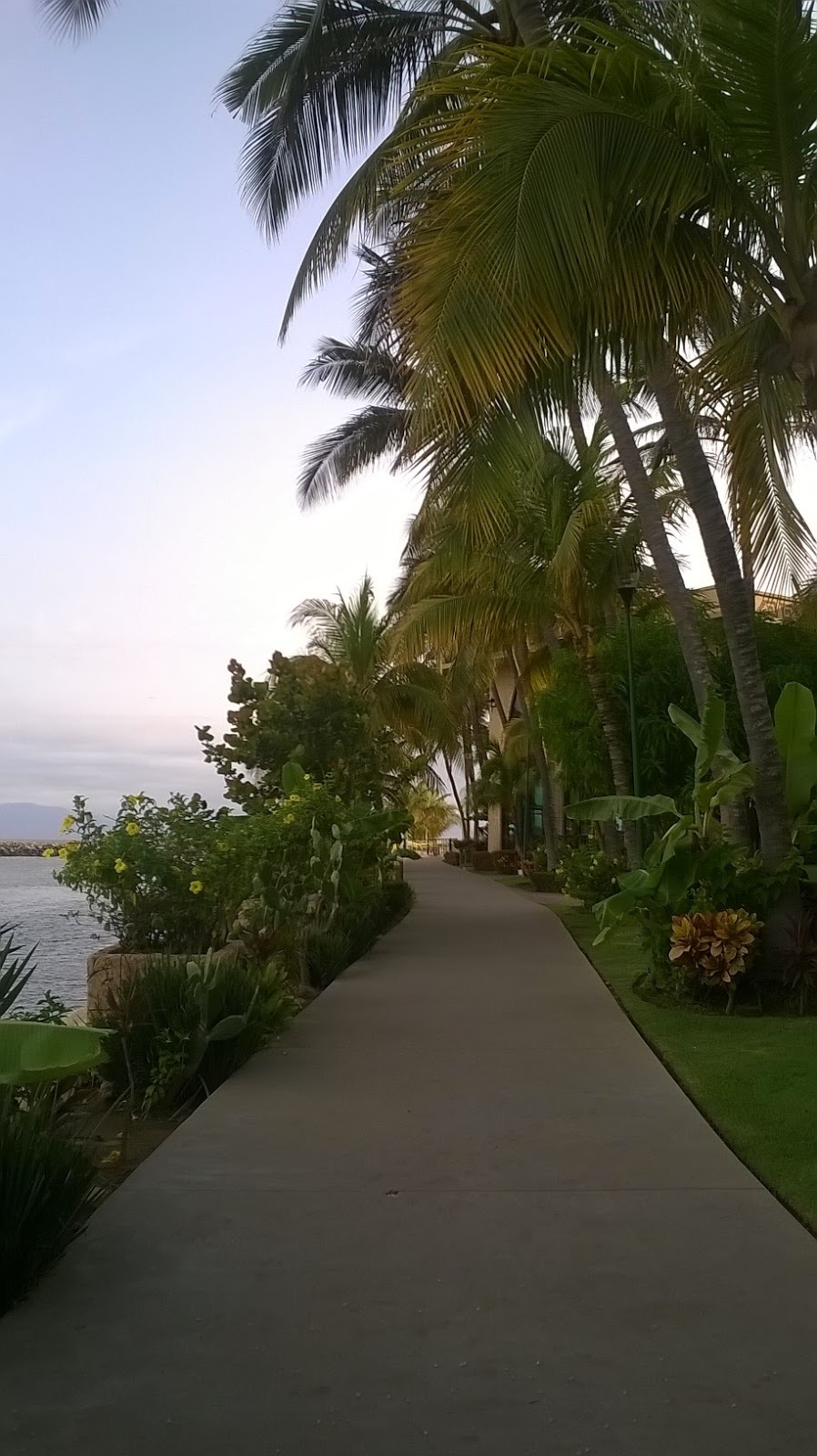
Pictured: The pathway from the marina to the beach.
Not Pictured: Iguanas! Lots and lots of iguanas!  They're everywhere and it drives Otter nuts. He's not allowed to go after them as they're a protected species. That and they know karate.

 
Iguana!
 
The palapa overlooking the entrance to the estuary. The marina is in the background.
A palapa is an open-sided structure with a roof made of dried palm leaves. They generally come standard with a fruity drink and a nice breeze but mainly I like saying, "Palapa!" 

Palapa! Palapa! Palapa!
 
Pictured: Beach-side view of Paradise Village (with palapas!)
Not Pictured: Me. I should be underneath a palapa with a fruity drink. Instead I'm taking this so-doesn't-do-it-justice photo.
 
A sea turtle laying eggs on the beach. Normally they do this at night but it was 6:00 pm and she probably wanted to get in on the two-for-one happy hour action.

Pictured: El Malecon in Puerto Vallartaa statue- and sculpture-lined boardwalk bordering PV's Old Town.
Not Pictured: Time-share salesman. The Captain figures if he keeps walking, they'll throw in three more bottles of tequila and a new car.
 
 Game of Thrones: Mexican Edition

Pictured: ???


Tuesday, June 14, 2016

Day 18-22 of the Third Voyage: In which we try to remember that (technically) there is no timeline which is why it’s called voyaging and not “three tickets to Aruba, please.”


The original plan was to spend about a week in Puerto Vallarta before continuing south to the Panama Canal. But mice, men, etc., etc.

In short (Ha! “In short”. That’s a good one!), three things happened that have caused us to reassess our timeline. First off, the windlass totally croaked. We had it checked out in San Diego right before we left—not because it wasn’t working, it was just a bit of preventive maintenance on one of the few systems that hadn’t crapped out on us yet—and the guy basically told us, “Maxwell makes a good windlass—a total workhorse. It looks like it was properly maintained and it’s in good shape, but you just never know how long these things will last. Just use it till it dies.” Fair enough. We took that to mean that yes, it was an older model but it still had a few good years left. No one thought it was sick. Who knew it was terminal? Needless to say a new one has been ordered and should be here in a week to ten days. Our timeline is officially out of whack.

Secondly, as long as we’re waiting on a windlass we may as well have the fuel delivery system looked at as the general consensus is that this is at the heart of the diesel’s deceleration problem. We really need to get to the bottom of this once and for all before the engine totally craps out on us while out in the middle of nowhere. And speaking of crapping out, we’re going to take this opportunity to have our head system overhauled—new pumps, hoses, etc. (For the lubbers, the head system is in fact the toilet and yes, “crapping out” is a literal as well as figurative term.) This would also be an ideal time to have the bottom scraped and the hull polished. Not to mention the Captain and I need to get busy on the varnishing before the sun burns it all off. So with the to-do list growing, our timeline is growing along with it.

And thirdly, word in the marina is that this year’s hurricane season is shaping up to be pretty active. Supposedly, southern Mexico and Central America are already getting hit with big weather (one couple made it 180 nm past Acapulco, didn’t like what they saw, and opted to return to Puerto Vallarta—that’s a long way to go to change your mind) and with this new equipment delay, our window for crossing the Gulf of Tehuantepec has all but closed. Editor’s Note: The Gulf of Tehuantepec is a nasty piece of business at the southern tip of Mexico. In the summer, it’s a breeding ground for Pacific hurricanes. In the winter and spring, it likes to kick up gale-force winds called (I kid you not) T-Peckers that extend up to 200 miles offshore and can’t be outrun. In the fall, you should just learn to love monsoons because there’s no way you’re staying dry. The absolute best time to cross is May and early June; the second best time to cross is November.

So the original timeline has been discarded and we have decided to stay put for the next few months. We should be okay. Puerto Vallarta is what’s known as a “hurricane hole” in that it sits in the middle of a very large bay (Bahia de Banderas) surrounded by mountains, the marinas are all somewhat inland among the estuaries, and the estuaries themselves are protected by the high-rise resort hotels that line the beach and take the edge off the winds.

Now if it sounds a bit like we’re trying to convince ourselves that staying here is a good decision, there’s probably some truth to that. After all, we had a plan! A strategy! An itinerary! A freezer, a pantry, a head, and a bilge overflowing with provisions! Dammit, we even had a stockpile of 520 coffee k-cups (enough to get us to El Salvador)! And yet here we are again at what seems like a standstill. But we know deep down that this is the right decision. If we leave in late October, the weather will be better; we’ll have more time to stop and enjoy the places along the way; we run a better chance of avoiding a T-Pecker; and, who knows, our Spanish-language skills might have moved beyond the “Me, Tarzan. You, Jane. Where store?” stage.

I’ll let you know how it goes.
Pictured: Our new neighbor! I shall call him Edmundo!
Not Pictured: The look of utter disdain he gave us right before he did a swan dive off the stern and swam angrily to the other side of the marina.
Pictured: A typical street in downtown La Cruz--a fishing village just north of Nuevo Vallarta.
Not Pictured: A pharmacy. First town in Mexico that didn't have one on every corner!
Pictured: Another typical street.
Not Pictured: Still no pharmacy. They might be missing an opportunity here!


Pictured: After-dinner mints at the cantina where we had lunch.
Not Pictured: Too late. You're already picturing it.


Tuesday, June 7, 2016

Day 15-17 of the Third Voyage: In which we arrive in Paradise ahead of schedule, but I’m pretty sure we took a short-cut through Hades to get there.


We left Cabo around ten in the morning in anticipation of a 55-hour journey across the lower Gulf of California to Puerto Vallarta. This was based on an average sailing speed of 5 nm/hour which, given the weather forecast, seemed completely doable. You see, the Captain had reloaded our GRIB weather software onto the new MacBook (herein to be known as the MexiMac) and the forecast called for winds out of the NW at 12-15 mph. Not a lot of wind per se but given a sea swell of only six feet at 13 seconds apart, we figured it would be a relaxing albeit leisurely sail. Unfortunately, the winds never materialized. The wind gauge was registering speeds of four to five with the occasional six thrown in for good measure. After a while, it gave up trying to calculate speeds that low and just displayed “meh” on the screen. And so the diesel was fired up and off we chugged toward mainland Mexico.

Now it stands to reason that where there’s no wind, there’s no breeze—and we weren’t even motoring fast enough to create one. And as the day progressed and the sun rose ever upward in the sky—its rays radiating off water that just got bluer and bluer the further south we went—the temperature started to rise. It quickly went from warm to hot to downright uncomfortable to holy cow how do people live like this?! (You’ve heard the phrase, “Hot as Hades”? Even the imps were fanning themselves.) Keep in mind that we have spent the last quarter century in the Pacific Northwest (motto: In God We Rust) where the first day of summer is July 5th (because it ALWAYS rains on the Fourth of July), it lasts about six weeks, and if the temps ever get into the 80’s you can be sure there’ll be a run on bottled water, air conditioners, and mesh shirts. So needless to say, some acclimation is in order.

But for now, we needed relief. So we put up part of the cockpit bimini to cut down on the direct sunlight and when that seemed to cool things down a degree or two, we decided to put up of the rest of it. Then as the sun started moving through the sky—its searing rays creeping underneath the bimini threatening to undo all our good—we pinned towels to the sides…then seat cushions, t-shirts, napkins, whatever we could get our hands on. I’m sure at one point we must’ve looked a little like one of those Chinese Junkets…or a floating blanket fort. 

But whatever we were dealing with outside was nothing compared to what was below. No breeze meant no air circulating down in the cabins. We kept the companion hatch and the side pilothouse door open to try to get something—anything—stirring, but were unsuccessful. We even tried opening some hatches—which after the great wave fiasco that necessitated the purchase of the MexiMac, we were loath to do—but that, too, proved futile. By late afternoon, it was about 95 degrees down below. We had to turn the Deck Boss over every fifteen minutes so she would roast evenly.

Needless to say, sleeping was difficult—which made for a long night. And it quickly became apparent that sleeping on deck would not be an option that night. The Captain, HMS Cliff, and I were doing three-hour watches and I had the nine to midnight. As I was scanning the horizon, monitoring the GPS, and watching the dark water glide by in the glow of our steaming lights, I had the weird sensation that I was getting taller. I reached up my hand and the bimini, which was usually about a foot above my head when standing, was now about three inches lower. It wasn’t raining. It was condensation from the humidity. I pulled some foulies out of the wet locker to sit on because nothing makes a three-hour watch miserable like a wet tush. By the time my shift was over at midnight, everything was damp and the humidity said, “Screw it; may as well just rain.” By the time HMS Cliff’s shift was over at 3:00 am, everything was soggy. When the Captain’s watch ended at 6:00 am, I’m pretty sure the mast had mildew.

Luckily, the next day was much kinder (or we were much smarter). Though still hot and unrelenting, the bimini kept the sun at bay and made things bearable. And by early afternoon we threw caution to the wind and turned on the air conditioning down below. We didn’t know if it would work (we’ve only ever used it at dock when plugged into shore power) but the condensers kicked in and we managed to get the interior temp down to a slightly-less-objectionable 82. The nighttime watches gave us a new sensation. For the first time ever—EVER—we didn’t need to put on extra clothes. No long pants, no shoes, no hoodies. It was that warm. Two o’clock in the morning and it’s warm! And not a weak, arid warm. A heavy, slightly sticky warm. One that says, “You thought today was hot? Wait till you see tomorrow. But for now…enjoy.”

About 7:00 the next morning, Banderas Bay came into view—about six hours earlier than planned. We found our way into Nueva Vallarta (about 4 nm north of Puerto Vallarta) and sidled into the guest dock at Paradise Village Marina. The sun was barely up and it was already hot and muggy and steam was rising off the water, but the foliage was lush, colorful flowers bloomed everywhere, and the cacophony of parrots and other exotic birds pierced the air.

When you’ve lived all your life in a temperate zone, it can be quite a shock to the system. We know it will take a while to get used to the climate. I guess it’s possible we’ll never fully acclimate. But given how beautiful it is, I can see why people live like this.
Pictured: 50 hours at sea makes a person hungry. The Captain about to tuck into a nine taco platter.
Not Pictured: The doggy bag. 50 hours at sea tends to make your eyes bigger than your stomach.

 
Pictured: Bananas! Just growing there along the pathway. Can you believe it?
Not Pictured: No, really. Bananas!

 
Pictured: An iguana! Just hanging out there along the pathway! Can you believe it?
Not Pictured: No, really. An iguana!
 
Okay...maybe some things will take a little longer to acclimate to.


Wednesday, June 1, 2016

Day 10-14 of the Third Voyage: In which things get off to a bumpy start but then…Cabo!


The evening before setting out for Cabo San Lucas, the Captain and HMS Cliff took the dinghy outboard apart, blew on everything, and put it back together again. It’s the mechanic’s version of “try turning it off and back on again.” Between that and reworking the fuel hoses for optimal flow, the outboard came back to life and there was much rejoicing. It’s the little things.

The next morning we got up just before sunrise to prepare for the voyage. Everything was stowed, the cockpit and decks were made ready, and HMS Cliff and I hauled up the first 50 feet of anchor chain to get a head start on the really heavy lifting ahead. While we did this, the Captain took Otter to shore for one last “terra-poopa”. After 30 minutes, they had not returned. We could see them on the beach, but had no way to get hold of them to see what was taking so long (New rule: always take your cell phone.) We scurried about doing the rest of our preparations. Another ten minutes went by. We could see the Captain leaning against the dinghy looking down the beach like he was waiting for something while Otter sat in the sand. HMS Cliff remembered a black truck stopping when the Captain first got to the beach. Was it the Federales? Had they questioned him and he was being “detained” in a way? (New rule: always take your passport.) We saw the Captain grab a huge rock and prop it underneath the dinghy. Another ten minutes went by (New rule: always take a book.) Finally, a truck drove down on the beach and a man got out and talked to the Captain. After a little bit, they removed the outboard and put it in the truck, they then manhandled the entire dinghy into the bed of the truck. They drove off. Had the Captain been kidnapped? (New rule: always take money.) Just as the panic started to set in--Who can we call? How do we get to shore?—the Captain and Otter came zooming across the bay toward Raven. It turns out that even though the waves didn’t look that big from the boat, they were hitting the beach at about four to six feet and he was just not able to get the dinghy past the surf. And when a wave turned them sideways and tossed Otter from the boat, all other attempts were abandoned. It turns out that the man in the truck was an official with the ecology department and a Good Samaritan to boot. He took the Captain, Otter and the dinghy to the other side of town where they could launch safely. It turns out that just a week before, someone else had tried to launch from that stretch of beach during a high surf and was not successful. The term used was “muerte”. So here’s a valuable lesson: when the cruising guide says that a dinghy may be landed on “the beach below the village”, it should be added that “waves may be bigger than they appear” from the boat. That, and always take your cell phone, passport, money, and a book.

And so it was we set out about two hours later than anticipated but the day was warm, the seas were calm, and the wind was just right for sailing. All in all a very pleasant day of passage making. But when the sun settled into the west and darkness fell, it started to get ugly. Because of course it would. And thus we spent yet another night of getting relentlessly tossed around. The Captain had taken us farther offshore to take advantage of calmer conditions (and to shave off miles to Cabo), but even 60 nm out was not enough to lessen the impact of the deep troughs. It was a sleepless night with watches made more challenging by the fact that there was no moon—just a dark, dark sky and a million stars. But stars don’t give off enough light to see the horizon so it’s very disorienting. Imagine being in a planetarium. You’re craning your neck looking up at a simulated night sky—inky blackness punctuated by a million points of light—but there’s a mast swinging wildly back and forth like a giant pendulum, your seat is bucking wildly, and it’s so dark you can’t see the exit sign. Oh, and you can’t get up and leave.

Thankfully, the seas abated by morning and we were blessed with good conditions for the rest of the voyage—about another 18 hours. At long last, about mid-afternoon, we caught sight of the famous “Land’s End” rock formation that signals the entrance to the harbor at Cabo San Lucas. Strong winds swept us along the coast, high waves crashed on the rocks, and we had to steer hard to maintain a course, but as we rounded the corner into the bay, the wind suddenly died down and it became immediately apparent that we had stumbled into party city. We were suddenly dodging luxury yachts, sport fishing boats, glass-bottom boats filled with tourists, and large catamarans crammed with dancing women in bikinis. And loud music coming from everywhere. At one point, a large sea lion jumped into the back of a passing yacht and I swear he was there to dance with the girls until it became obvious that he was actually after the bait fish swimming around in their onboard tank. The fact that everyone kept dancing as if nothing out-of-the-ordinary had happened just augmented the party vibe.

We got situated at our slip in the IGY Marina and headed up to shore—forty plus hours at sea makes those first hours on land quite interesting (you can’t decide if the ground is swaying, you’re swaying, you’re drunk or everyone’s drunk—although given Cabo, it’s probably the latter), but it was good to be walking. A long promenade goes from one end of the harbor to the other, encompassing two marinas, and it’s lined with restaurants, bars, shops, and duty-free stores. Small kiosks are everywhere selling excursions and time-shares and locals walk up and down selling everything from hats and hand-carved figurines to cigars and silver jewelry. It’s hot, humid and chaotic, but it’s fantastic! I can see why it’s so popular. It’s not any place I’d want to be for any length of time, but for a two to three day stopover, it’s a blast.

Yet there is always work to be done. On our first full day, the Captain and I cabbed it over to the local Office Depot to procure a new MacBook. If you can wait to make an electronics purchase in Mexico, do it. Compared to what we would have spent stateside, we saved over 30%. The only difference? The Mexican MacBook has an extra key or two – okay maybe 5. The Captain can now type niño without having to jump through a lot of hoops to get that little squiggle over the “n”. For a few more pesos, he could have gotten a gold MacBook, but he thought that might be a little too flashy. As for our old one? We discovered that it’s the perfect size and shape for lodging underneath the microwave to keep it from skidding all over the galley counter. We call it the “iwedge”.

After a provisioning trip to Walmart and the local supermercado, doing some engine and transmission maintenance, cleaning the boat inside and out, and doing copious amounts of laundry, Raven is ready to head out to Puerto Vallarta. But more importantly, after a couple days of rest and some long, leisurely meals at some of the local watering holes, I think we’re ready too.
Pictured: The Captain catching a beautiful 10-15 lb. dorado. We let this one go; there'll be others.
Not Pictured: The dorado's wife tapping at her watch and saying, "We were due at the Wilson's two hours ago! This had better be good!"
Pictured: Land's End coming into view; 25 knot winds created some chaotic conditions
Not Pictured: The other side; boaters 25 sheets to the wind created some chaotic conditions 


Pictured: A view of the harbor
Not Pictured: The sea lion. He's piloting the 200-person catamaran in the back of the photo.
Heard: Who Let The Dogs Out! Woof-woof-woof-woof-woof!
Pictured: Another view of the harbor; the fishing charter dock. Why yes, that is the Ya Hoo! second boat in.
Not Pictured: The yahoo asking the guy at the kiosk, "I want to do some fishing. Are there any boats around here?"
Pictured: A typical Cabo San Lucas side street. Only one of those cars is parked.
Heard: Who Let The Dogs Out! Woof-woof-woof-woof-woof!